
“Freedom and Passion for Humanity”: Elegies of the Earth: Selected Poems by Ahmad Shamlou, reviewed by Samad Josef Alavi
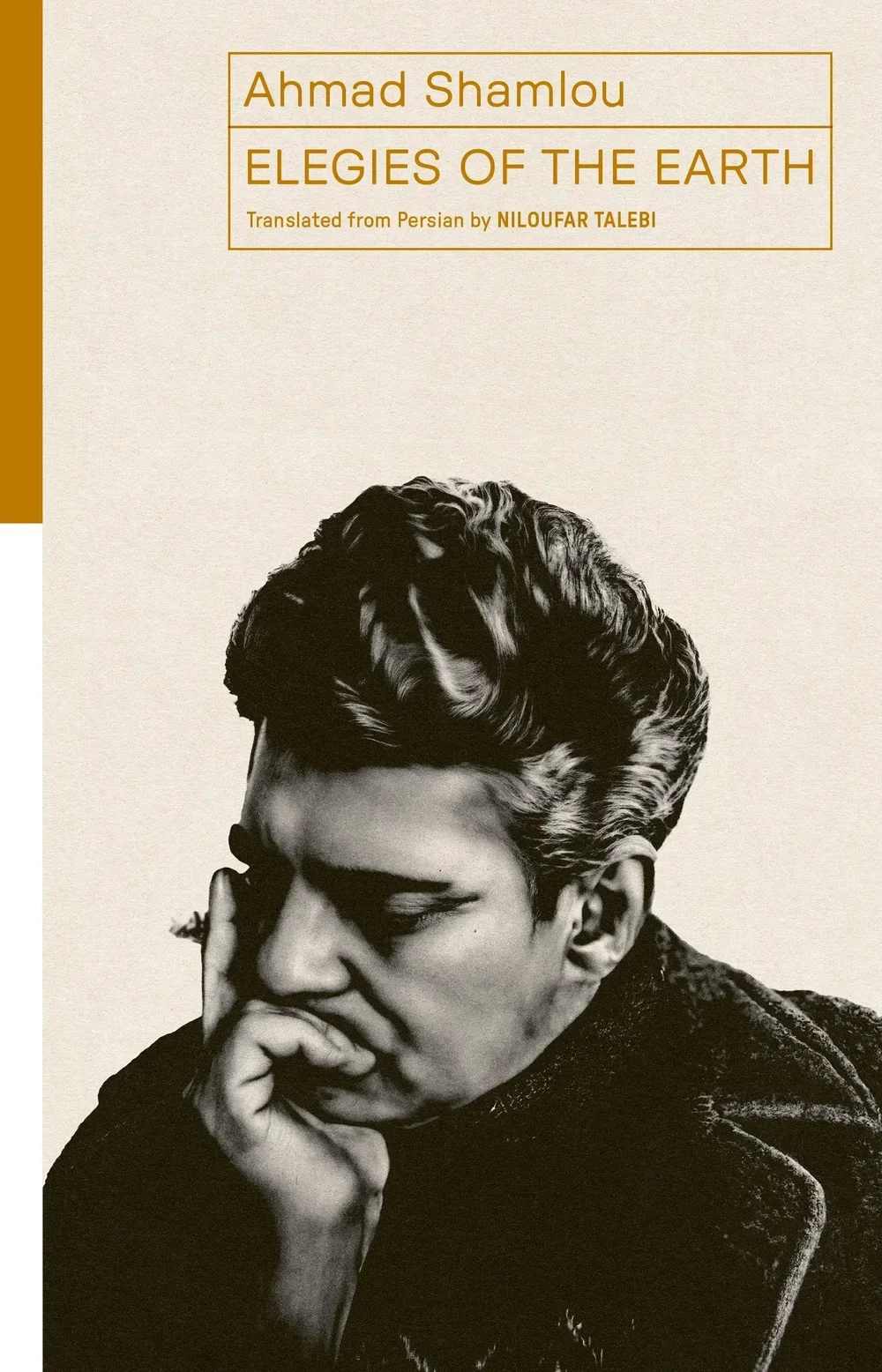
Elegies of the Earth: Selected Poems By Ahmad Shamlou
Elegies of the Earth: Selected Poems
By Ahmad Shamlou, edited and translated from the Persian by Niloufar Talebi
New York: World Poetry Books, 2025
312 pages
Ahmad Shamlou (1925-2000) wrote a poetry of love. A cultural giant in twentieth century Iran, Shamlou often gets called the “poet of liberty,” a nod no doubt to his calls for people’s liberation around the globe and to his mission to liberate poetry from tradition’s bonds so that he could write a truly free verse. But to grasp Shamlou’s preoccupation with freedom, you also have to sense the passionate love that drives his work, a passion above all else for humanity and humankind as fundamentally creative beings. Sometimes Shamlou’s poems express love directly for the common people: The tree speaks with the woods/ the weed with the field/ the star with the galaxy/ and I / speak with you… (“Common Love,” 1957) while at others they express reverence for revolutionaries so filled with love for their people that they willingly give their lives in battle or before firing squads in the name of a liberation to come: Ah, of whom am I speaking?/ We live unaware of why/ They die well aware of why. (“The Chasm,” 1975). But even in his romantic odes to his muse and (third) wife, Shamlou’s love comes out as a celebration of the human being: Your lips,/ tender as a poem,/ turn the most carnal kisses into innocence so pure/ they could make a caveman human. (“Aida in the Mirror,” 1963). To be human, for Shamlou, means to be endowed with a unique potential to imagine and create new worlds. You don’t demand that individuals be left free to make their own destinies, as Shamlou’s poems do again and again, if you don’t, on a profound level, feel love for your fellow human being.
On the 100th anniversary of Shamlou’s birth, editor and translator Niloufar Talebi has given us her own triumphant labor of love, a collection of eighty poems rendered sensitively into English and presented with the original Persian on the facing page. Elegies of the Earth spans fourteen collections of Shamlou’s poetry and almost fifty years of his prolific output. Talebi’s is not the first book of Shamlou translations in English—Love Poems of Shamlou (2005) and Born Upon the Dark Spear (2015) come before hers—but Elegies of the Earth represents the most ambitious effort yet. Talebi spent almost two decades working on the collection and chronicled some of the journey and its challenges, not to mention her love for Shamlou’s poetry and her personal friendship with the poet, in her memoir Self-Portrait in Bloom (2019). She has also adapted Shamlou’s poetry into an opera (Abraham in Flames) and other multi-media works. All these years of engagement show in the translation, with every carefully chosen word at once fiercely loyal to the Persian, as suggested in no small part by the presence of the original Persian text, while at the same time inventive and fresh in English. You can only imagine how many revisions she must have gone through before landing on tightly crafted lines like I can’t help but be beautiful, / a flirtation in eternal light.// I’m so beautiful/ that spring spontaneously bursts into bloom in my wake:/ in my world/ blood/ is never the spirit laid bare/ and the fear of lead/ doesn’t deter the partridge/ from its strut (“I Can’t Help But Be Beautiful,” 1983).
I can only hope that the kind of loving effort that brings Elegies of the Earth to the page will inspire new readers to discover Shamlou’s spirit of revolutionary humanism. We need that kind of love now more than ever.
Elegies of the Earth is available worldwide here.

Samad Alavi teaches Persian and Middle Eastern Studies at the University of Oslo. His writing and translations have appeared in journals including Michigan Quarterly Review, Iranian Studies, and the International Journal of Middle Eastern Studies.