
“Dynamic Identity”: Carol Parris Krauss’ Review of IF I HAD SAID BEAUTY by Tami Haaland
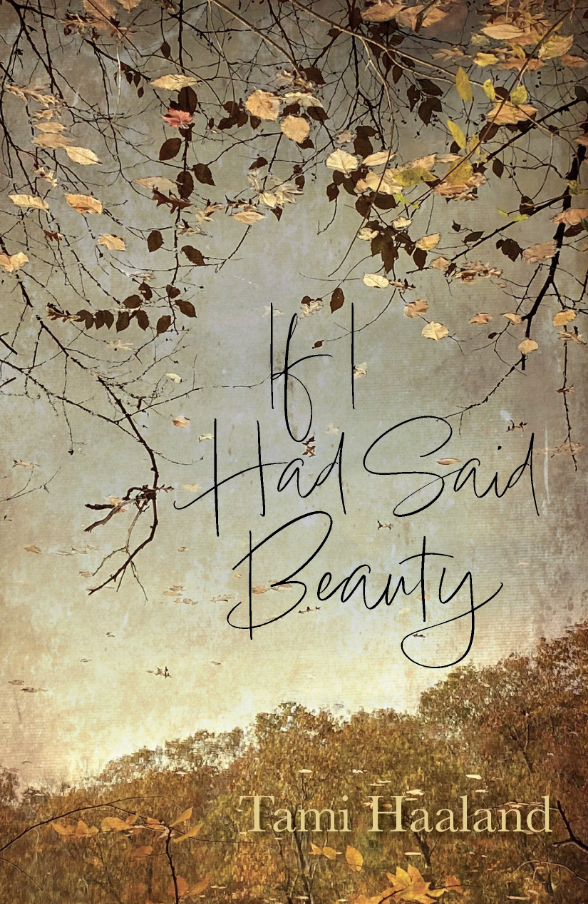
If I Had Said Beauty
Tami Haaland
Lost Horse Press, October 2025
65 Pages
Tami Haaland’s If I Had Said Beauty, her fourth collection, delves into the impact our ancestors have on us, the traits we have acquired from known and unknown kin, our sense of place, and the concept that humans have an ongoing dynamic identity rather than a static one.
I found myself circling back often when reading this collection. As soon as a specific theme appeared in a poem, such as using DNA as a lens for revealing identity, another layer surfaced, revealing yet another genetic concept, such as evolution, which shapes who we, the readers, are. But Haaland’s lyrical poems do so much more than that – they reflect on ideas such as loss, beauty, and becoming, often set in nature or shown through animals.
The first stanza of the opening poem, “Prelude,” presents the idea of an evolving identity: “…Call it selfish, this I, a window out a door, a quirk of time and space, a place for a little while before it dissolves into constituent elements and becomes reinvented as insect, rabbit,”….. and the next stanza of “Prelude” brings us to Haaland’s ancestors from Scandinavia, Britain, Ireland, and Germany and how those ancestral lines, “ …go deeper, become invisible, lead everywhere and nowhere….” Inherited traits across space and place unfold in this poem.
The book is divided into three sections that reflect the author’s quest to explore who she is and to allow herself to continue redefining herself. Section One reflects on origins and deep time. Then the second section of the book explores the present self and its many identities, with the concluding section concentrating on family and legacy.
In the poem “The Self Considers Her Alternate Selves,” Haaland also touches upon possible or actual loss in the poem, “…the car spinning on black ice, a sudden oncoming truck, a birth gone awry…” These two ideas (alternate selves and loss) course through our DNA hourly, if not by the minute. We are all multifaceted – the teacher, mother, poet - and we all fear loss for ourselves and our village.
“Who Are You Dead” explores the complexity of getting to know our ancestors and recognizing what we might never know about our people. We carry their traits and their DNA, but as the poem suggests, do we know their secrets, or the physical and emotional battles they fought?
“Saints and assassins, hands turned
to their work. Ancestor against ancestor
in wars or petty dispute, and still
one from each side form a couple,
a lineage. A woman forced,
a love lost to a genealogical chart.
Secrets I can’t get to.”
In “Home,” Haaland writes of the affinity for adults to continue to refer to their childhood home as “home.” How time and space can’t cut the invisible bonds that tie us to a space of belonging that we no longer occupy.
“When we lived together, when my
mother and father, my brother and I
still lived in our house, my mother would say she
was going over home, meaning back to
her parents…”
Understanding who our ancestors are beyond their genetic makeup, and identifying our home or homes, is not an easy task, but an immersion into If I Had Said Beauty by Tami Haaland will have readers reflecting about those they call their people, their place, the biology found in recessive and dominant traits, the concepts of Microblome and Mitochondrial Biology, and the power of poetry. And it is through the power of Haaland’s collection that the dominant trait of poetry lives in body and soul.

Carol Parris Knauss is honored to have published poetry in Louisiana Lit, the Arkansas Review, Salvation South, Eclectica, One Art, Story South, The South Carolina Review, and the Mid/South Sonnet Anthology, among others. Fernwood Press published her full-length book (Mountain.Memory.Marsh.) in November of 2025. Carol was born in S.C., to mystical mountain people, raised in NC, and attended Clemson University. She currently lives in Virginia with her St. Bernard, Martha June.