
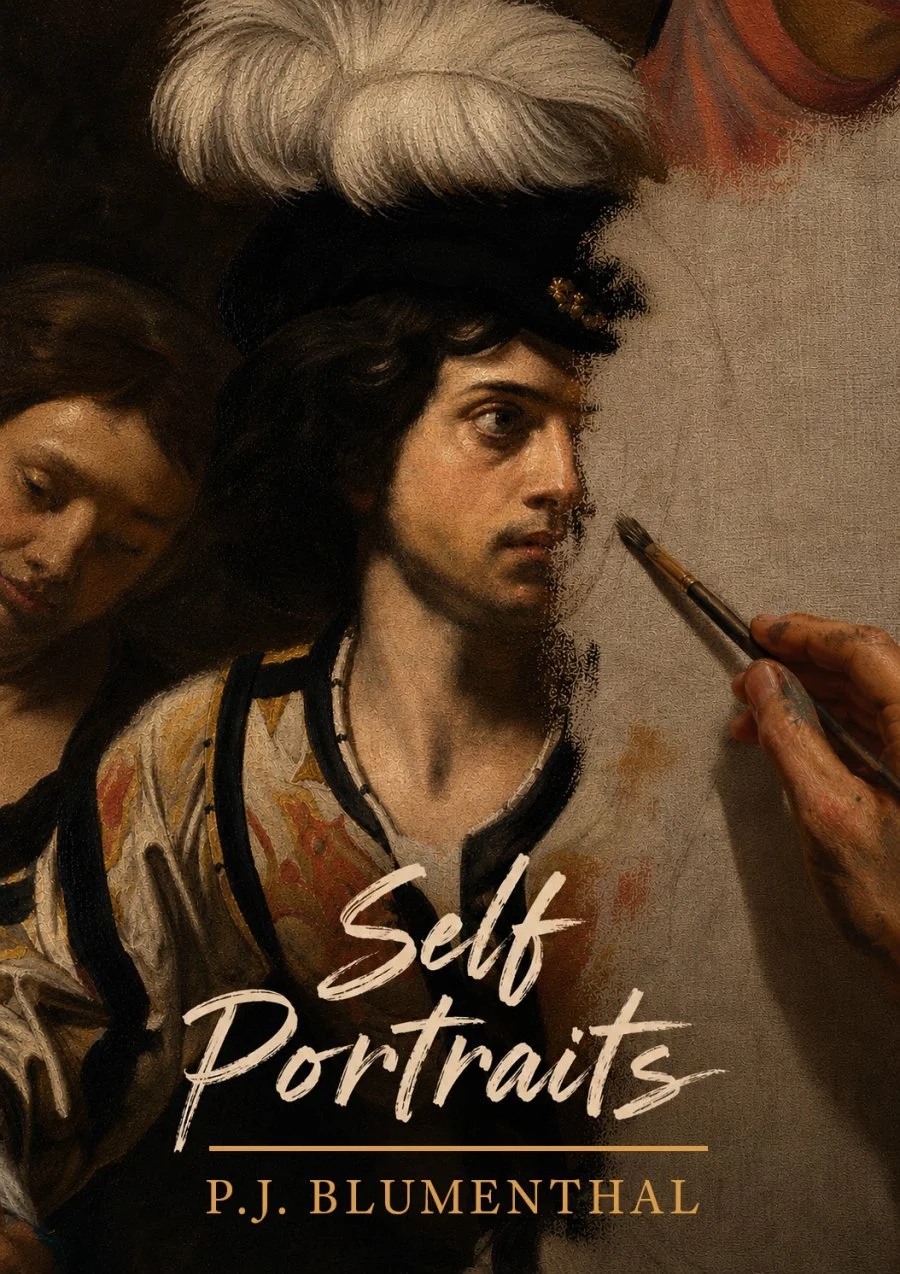
Self Portraits
PJ Blumenthal
Sagging Meniscus Press, October 2026
280 pages
There is a particular pleasure in being confused by a short story collection. Not frustrated or lost, exactly, but left with the sense that something happened to you that you cannot quite explain. P.J. Blumenthal’s Self Portraits embraces that feeling from the beginning. In his note “To the Reader,” Blumenthal writes that his self portraits, like mountains, “are meant to be experienced not understood.”
Blumenthal’s stories are strange, funny, intimate, surreal, philosophical, and occasionally absurd, often all within the same collection and sometimes within the same story. A mysterious figure with no eyes and no mouth becomes the center of a Bronx legend. A translation center may translate not just words but the people who enter it. A library roof exists somewhere outside the boundaries of ordinary memory. These premises sound like the beginning of puzzles, but Blumenthal is less interested in solving them than in exploring what it feels like to encounter them.
That uncertainty is partly created by the way the stories are told. Some take the form of a narrator recounting a friend’s or neighbor’s story. Others begin with works of art, photographs, murals, museums, or lost writings. Several feel almost like interviews or investigations, as though the narrator is trying to reconstruct an event that has already started to slip out of reach. This distance creates an intriguing uncertainty. What actually happened? What did the narrator remember correctly? What changed between the event itself, the person who experienced it, the person who later told the narrator about it, and the version that ultimately reached the reader?
Perhaps that is what makes the stories feel so unique. Ten people could read this collection and come away with ten wildly different interpretations, each bringing something of themselves to the work.
But the stories don’t just invite interpretation; they draw the reader into their worlds. “The Murals” offers one of the clearest examples: the narrator discovers a mural he has never noticed before and eventually enters it. The premise is absurd, but the experience of stepping into an artwork feels oddly natural within the collection. “The Other Side of the River” creates a similar sensation, with the narrator arriving somewhere mysterious and simply beginning to accept the strange rules of his new existence. “The Museum of Victimology” pushes the idea even further, trapping its reader inside a curator’s unsettling monologue. The curator addresses the visitor directly, explaining the relationship between beauty, desire, and pain.
It’s funny, disturbing, and completely disorienting. More importantly, it turns the reader from an observer into a participant. Reading Self Portraits can feel like wandering through an exhibition where some rooms seem to have doors connecting them, even if you can never quite find those doors. The stories echo one another without necessarily explaining one another, leaving readers to decide whether they are discovering connections or creating them.
The title Self Portraits adds another layer to this uncertainty. These stories are not conventional autobiographical portraits, and Blumenthal himself seems almost playfully wary of the assumption. In “To a Friend Whose Works Have Come to Nothing,” he jokes that he usually avoids writer narrators, lest readers assume he cannot imagine people who are not writers—or that he is writing about himself. Later, he directly jokes with readers who might suspect that a story is really about him. Yet many of the collection’s narrators are writers, storytellers, observers, or people attempting to make sense of someone else's story.
In an interview about the collection, Blumenthal describes Hokusai as a model for his approach to self-portraiture, explaining that the self may take center stage, hide in a corner, or disappear behind a cloud. His stories seem to operate similarly. The author is sometimes visible and sometimes obscured, but even when a narrator is telling someone else’s story, the act of looking becomes its own kind of self-portrait.
“The game is fixed and the cards are marked,” Blumenthal writes in the first story. It feels like a warning: we will never have all the information. We will not always know which version of a story is true, whether two stories are connected, or whether we have understood what we just read. But the cards are on the table, the stories are waiting, and the reader gets to decide what to do with them.

Allison Renner is the author of Green Light: The Gatsby Cycle and Won’t Be By Your Side. Her fiction has appeared in Ghost Parachute, SoFloPoJo, Gooseberry Pie, Roi Faineant, and others. She can be found at allisonrennerwrites.com.