
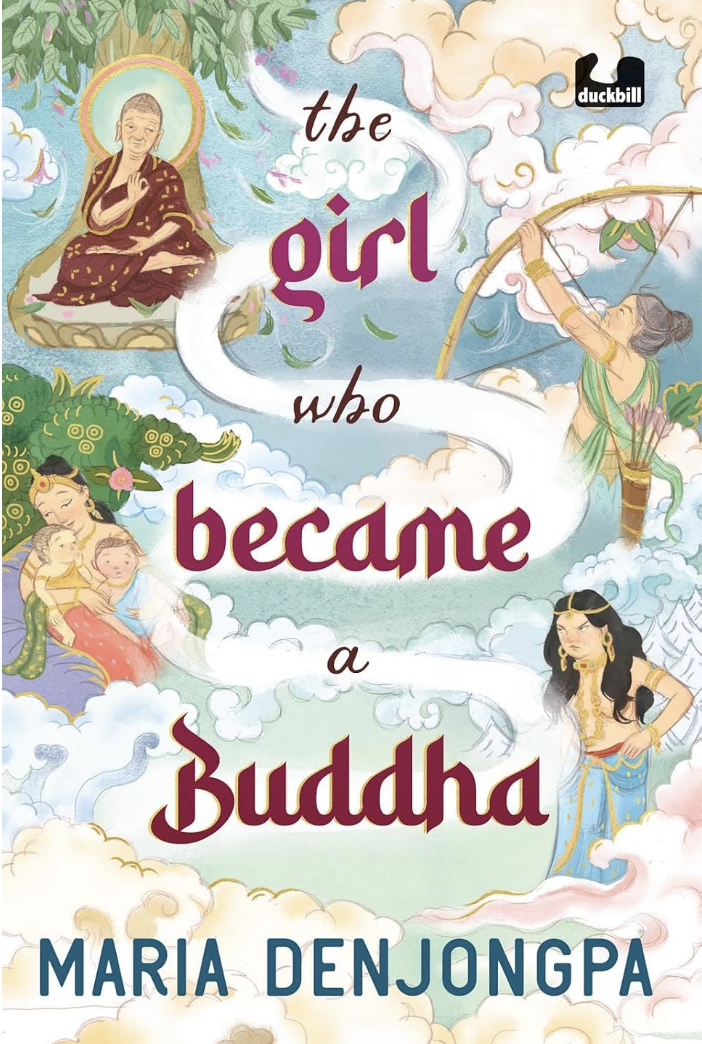
The Girl Who Became a Buddha
Maria Denjongpa
Duckbill Books (2026)
321 pages
Fifty years ago I read Robert Pirsig’s Zen and the Art of Motorcycle Maintenance, a story much more about philosophy than motorcycles. Over the course of the next twenty years, I reread the novel four times, inching toward understanding—and feeling—the book’s central idea: Quality.
I’m thinking about that book now, after reading The Girl Who Became a Buddha—though I’ve only read Maria Denjongpa’s book twice. Pirsig’s story was for me a page turner, an odyssey that began on a motorcycle and morphed into a history of philosophy—and then into a meditation on the power of mindfulness. The Girl Who Became a Buddha does something akin, though in a very different way, at a very different historical time, and in a very different part of the world. It too is a deep meditation on mindfulness, on what it means to pay attention. It is also a story of deep suffering—and how one might escape it. As Italo Calvino wrote at the end of Invisible Cities, "the inferno (is) where we live every day, that we form by being together. There are two ways to escape suffering it. The first is easy for many: accept the inferno and become such a part of it that you can no longer see it. The second is risky and demands constant vigilance and apprehension: seek and learn to recognize who and what, in the midst of inferno, are not inferno, then make them endure, give them space.” Denjongpa’s story is about the second, risky way. We feel the characters through their journeys, through the stories of discovering “who and what are not inferno." There are direct teachings in the novel too, especially in the latter chapters, and I freely confess to savoring them.
In one sense, The Girl Who Became a Buddha is a story for young adults: it has simple, straightforward language, short chapters, and an exciting plot. It’s a first-person account of an historical figure journeying toward unpredictable and life-changing outer and inner destinations. And of course it’s a story of the Buddha too, journeying toward an Enlightenment that would change the future of the world.
But it’s not only for young adults; it’s for anyone open to a story of spiritual awakenings. The novel delighted this reader, twice, and it made him think hard about the characters and about life, most especially about the problems of evil and suffering, problems that every religion must contend with. How wonderful to discover a page-turner that left me contemplative yet wanting more. (Ah, wanting more: clearly I’m light years away from Enlightenment.)
The story is well-known. Siddhartha, protected by his royal family from experiencing—even witnessing—human suffering, eventually learns the truth of human life and embarks on a quest to find a cure for that suffering. But this is outline, hardly story, what, not how. Denjongpa’s gift is to breathe believable and profound life into the famous tale, and to do it by centering her story on Queen Pajapati. She was Buddha’s adopted mother, and Denjongpa chronicles her odyssey from selfish, indulged, and headstrong royal to Buddhist monk—and then to actually becoming a Buddha herself. Accompanying her is a cast of memorable characters—some admirable, some despicable, most human and, as the book teaches, all worthy of compassion.
The Girl Who Became a Buddha wears its learning lightly. The story is clearly rooted in the author’s spiritual practice, as Denjongpa draws upon her "own Buddhist teachers’ remarkable blend of transcendence and earthliness to imagine what Buddha and Mother Pajapati might have been like.” And that’s precisely what she conveys in her story: earthiness and transcendence. We feel the “loud disobedient girl” that Pajapati was, the young woman who struggles to control her anger at her patriarchal masters, wishing suffering on those she is hurt by. We feel Pajapati’s disappointment in her vain daughter Sundari, who cared about “ribbons and fabrics and jewelry, and was bored with everything else” and Pajapati’s despair at Siddhartha’s disappearance, immediately after his son is born. And we feel the wisdom of the Buddha often, in, for example, the teaching “that there is only one caste and that is the caste of birth, sickness, old age, and death.” Such teachings are integrated and essential to the story, never imposed nor didactic.
“Will anyone remember us? Will those who live a thousand years from now have even heard of Mother Pajapati? Will they know that the woman who raised Buddha became a Buddha herself? And that a small band of hungry, angry women were inspired by her journey? And transformed by her determination and her love?”
Some will. That’s the power of enduring literature, and The Girl Who Became a Buddha will help keep Pajapati alive—and, more important, inspire young, middle-aged, and old readers alike, those who demand a good story—but also inspire those who yearn for deeper truths.
“‘It is my duty to offer the medicine,’ Buddha always said. Whether you take it or not is up to you.”

Charles Newman is a retired international educator who’s taught in New Delhi, Karachi, Tokyo, Moscow, Gangtok, and most frequently, Budapest. As well, he worked for thirteen years at Waring School in Beverly, MA. Though primarily an English, History, and Humanities teacher, he’s taught students at every level between third and twelfth grade. Since 2017 he’s been teaching literature courses to adults as well. Charles earned his MA in Literature from the Bread Loaf School of English and his undergraduate degree from Columbia University. He and his wife Suzanne recently returned from a month in India, where they trained teachers at the Taktse International School, in the foothills of the Himalayas.