
“How to Spend a Cold Monday in Chicago” by Gail Siegel
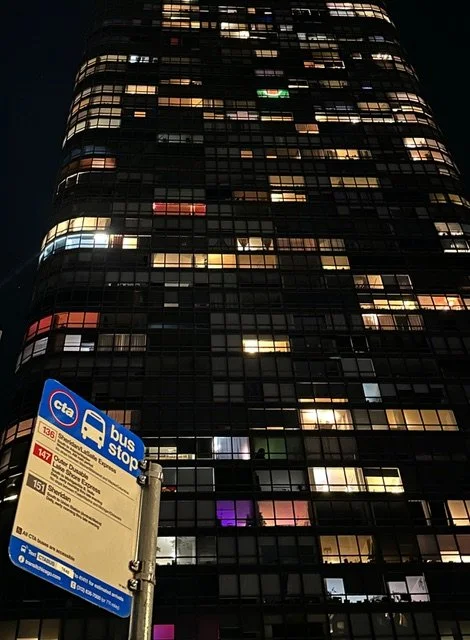
Photo Credit: Gail Siegel
First, meet your friend Lina. Ignore the brutal cold and leave your car at The Big Pink—her condo on the lake—and ride the 147 Bus south to the Art Institute. Stop at the member lounge and split a tiny, overpriced croissant. It won’t bother you; you will be too busy talking about the war in Iran, weaponry murdering the climate along with people.
Delight in Matisse’s Jazz paper cutouts. Meander through 2,000 years of Korean Art. Linger at Raqib Shaw’s Paradise Lost mural, which redefines the word “mural.”
Despite Trump’s reign of death and destruction, you will still savor beauty.
The museum will close. Hop on the northbound 147 and exit at Foster, a mile from The Big Pink. It remains painfully cold, but you only need walk three blocks to Kie-Gol-Lanee, the Oaxacan place which will warm you with tortilla soup, and a tlayuda that is easier to chew than the one you and Lina shared in Oaxaca. Tip well, as if cash can ward off ICE’s proclivity for brown cooks and servers. Begin trekking to Lina’s condo and your car. It was dusk when you entered Kie-Gol-Lanee. Now the sky will be a bleak urban black.
Check for your phone and glasses case. They are secure in your bag. You and Lina will recall the many times you’ve lost glasses, once at her place. Be glad for double-checking.
You will tighten your hood against the 20 degree numbness and 45 MPH gusts. Then pick your way cautiously along the sidewalk, since the other kind of ice lurks invisibly at night. Lina’s just told a harrowing tale about skidding, flipping and totaling a car in her 20’s. You won’t want to fall.
A few blocks from Lina’s you will notice your shoelace dragging. Near Balmoral you find a bus shelter cowering beside a chainlink-fence pocked with DANGER and KEEP OUT and NO TRESPASSING signs. You will prop your foot on the bench and re-tie your shoe, double-knotting like a child.
The bitter wind is scraping your faces, and you will be relieved to cover the remaining blocks to The Big Pink, to buckle into your car.
Except. Except. When you toss your bag inside it will seem rather…flat? Light? There is no phone, no slotted case brimming with credit cards, cash, driver’s license and bus pass. There is no glasses case. You will try to ping your phone with your watch but it will fail; the phone can’t be found.
What next? Only the obvious. You must walk the .7 mile back to Kie-Gol-Lanee, scanning the concrete for a phone and a glasses case. Then, Eureka! Your watch will “find your phone” and you will feel lucky when it reads just .2, then .1 miles away.
But, so sorry. Without warning, your watch will betray you and die, face gone black. Feeling bereft, you will ask each person you meet if they’ve seen a phone until finally, one man says he will call it. It rings. He walks in one direction and you in another, but you both strike out.
No matter. You will keep going, trudging the whole chilly route back to Kie-Gol-Lanee, dodging ice. You will only slip once. Inside, you will scribble your email on a menu should someone bring the host your treasures. You know they won’t, but diligence feels better than negligence.
Turn back. Pass the condos. Pass the apartments. Walk through alternating pools of streetlight and citydark. Pass the gas station and parking lot and the building surrounded by scaffolding. Pass the chain-link fence with its menacing placards. Pass the 7-Eleven and scour the sidewalk with your eyes, hoping that without your glasses you are not too blind. Arrive at your car, defeated. You will note that you’d left it unlocked, flashers winking scarlet.
It will take fifteen, maybe twenty minutes to drive home squinting. You will cross into Evanston while plotting next steps: locking credit cards, bricking your phone, buying a new one, replacing your license, ordering glasses.
In your kitchen, the dog-sitter will be tidily wiping your pup’s paws. But you will tromp snow and ice and dirty water across the white tiles to reach your laptop and start cancellations, start bricking. Try to cancel a card. You will be stymied when the website asks to verify it’s you by calling or texting your phone. It’s funny that you can’t prove you are who you are. You won’t laugh.
To brick your phone you open the “find my” app. You will watch a phone icon pop up at Balmoral and Sheridan. That’s the bus shelter, but your phone is on the wrong side of Sheridan, near a high-rise driveway loop.
You will backtrack with your dog riding shotgun. You will push through yellow lights that you should not risk. You will speed. You will tempt fate, not caring that Chicago’s Finest might pull you over and demand your missing license. Why not go for broke?
At Balmoral, you will feel a spark of possibility. Here is the high-rise driveway. There is the bus shelter. You can park in the one and inspect the other—the shelter. You do it, blinkers blinking red again. You can almost feel your phone in your hand.
But it will not be there. Not on the bench, not under the bench, not near the streetlights, or scaffolding, or slippery curb. Zip. Zero. Zilch. Nada. Rien.
Well, it won’t hurt to ask the high-rise desk clerk if anyone found a phone. You will expect nothing, but have nothing left to lose. The clerk will be on a call, working. You will wait while Door Dashers and Uber Eaters revolve through the glass doors. When the clerk wraps up, you pose the question. He looks puzzled. Then brightens.
Oh yes, he will say. A guy came in earlier. An Indian guy. He’d found a phone and a green case. He didn’t know what to do with them.
You will be elated! Someone found your phone. But as quickly as you inflate with hope, the desk clerk deflates you. He’d told The Finder nobody’d reported a lost phone. Return it, the clerk had told The Finder. Put it back where you found it. It’s where the owner will look.
Explain that you searched the bus stop. The clerk will pinch his lips, at a loss. No, he didn’t get the Good Samaritan’s name. No, he didn’t take a number. The kindly Finder’s unfindable.
The clerk looks guilty, so you will ask him to call your phone. The Finder might still have it. But your own voice answers. Technological trickery and misdirection!
Demoralized, you will retrieve your laptop from the car, log into the high-rise wi-fi, and start texting The Finder. Hi, you will write. I heard you found my phone. I will happily give you a reward. I am at the high-rise.
You will watch the little speech dots dance, encouraged. Time drags until you grasp they are tracking your own typing. You are talking to yourself.
The desk clerk will get a call. He perks up and your heart leaps. Could it be the Good Samaritan? No. It’s another staffer who’d been there when The Finder came. He got no name either. But the two men guess The Finder lives across Sheridan. At 5400. You are doomed to keep hunting.
Car still flashing emergency lights, dog still locked inside, laptop still perched on the high-rise desk, you will ignore traffic lights and cross the icy street in a daze. 5400 Sheridan is modest, has no reception desk—only a digital call box. The door is locked. You will scroll through the directory, call each Indian name on the screen. Manjhi, Sahu, Patel, Patel, Sharma, Patel, Patel, Patel. No one will answer. You will leave one garbled message. You can’t ask anyone to call you when they have your phone.
Exhausted and resigned to your expensive disaster, you will start shuffling back to your car, then halt and detour for a final stop at the bus shelter. Nothing has changed but the weather grown glacial. Your phone is still not on the bench or under the bench or near the scaffolding or malevolent metal fence or the streetlight or the curb or in the snow.
You will gaze upward. Maybe The Finder thought to stash it elsewhere. You’ve placed hats and water bottles and gloves and keys and jackets atop picnic tables and stop signs and fenceposts. Not on the ground.
So, you will peer everywhere. You pause at a dark green metal box on a stand with no apparent purpose. To monitor traffic? Surveille immigrants? Their supporters and sympathizers? If there’s a camera, it’s well hidden. The box looms overhead and you cannot see the top. So you will step back and catch a green flash. Bright green, like your case. If you stand on tiptoe and stretch, maybe you can reach it. And you do. It’s your glasses case. And with it, your phone.
You are gobsmacked. Did you really think you’d find it? Did you still have hope or had you lost it with your riches? You already can’t say how you’d felt, optimistic or pessimistic. Despairing? Or confident? Determined, perhaps. Stubborn, of course. Persistent, like the feminist you are. Freezing, certainly. Bone tired.
Crossing Sheridan this time, you will watch for cars. No point dying now. You must retrieve your laptop. The clerk who’d failed to get The Finder’s deets will be stoked. He will scold you to zip your bag; you will insist that you did. Had slinging it back when you re-tied your shoe pushed the zipper agape?
He will say, Get a bigger, better bag. What do they call them? A Birkin bag.
You will grin and shake your head. They are expensive, you say. Ecstatic and gratified, you show him your haul. That The Finder left everything, even three crumpled twenties.
Here, you will say, offering a twenty. If you see that guy again, give him this.
The clerk will protest, not knowing The Finder.
But you’re on a high, cheered by any kindness in this godforsaken world. Honesty, even with a monster at the helm. You will say, Well then, you give it away.
He will smile again. Maybe because he’s a paltry twenty dollars richer. Maybe because your naivete amuses him. Maybe because there is pleasure in happy endings, even for bystanders.
Go ahead. Shake his hand. You will both sleep better than you might have. One of you with twenty bucks more, one with twenty less, and the anonymous Finder with extra good karma —worth more, you’d wager, than a twenty. Or twenty times twenty. Worth far, far more than what Trump might extort, or anything money can buy.
Artist Statement
A novelist-friend recently mentioned that his French editor didn’t understand why American writers don’t address politics in the media and in their work. I considered what kinds of novels sell in the contemporary U.S. The internet tells me they are romance, thrillers/mystery and fantasy. Dystopian and young adult novels also rank high. Perhaps those writers grapple less with pesky things like politics. But the collapse of liberal democracy infuses everything I think about and do. Even losing my phone. To me, we are slouching toward dystopia at an accelerating rate. So while a quotidian problem might have once simply been an amusing story, it can now feel like a moral test. I think that’s evident in how I came to my piece, Cold Monday.
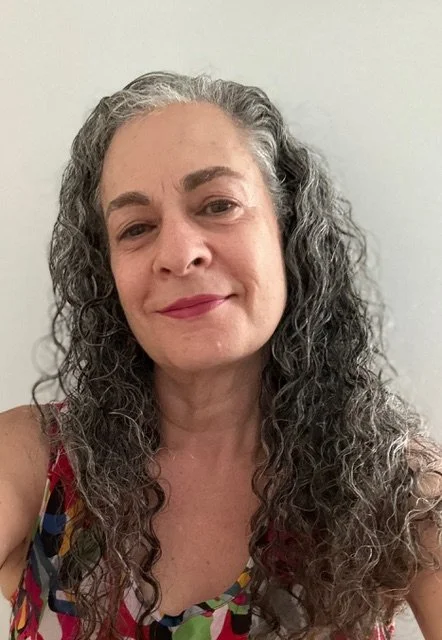
Gail Siegel’s prose has appeared in dozens of literary journals, from Agni, Ascent, FRiGG and Elm Leaves, to Post Road, Wigleaf, Zoetrope All-Story Extra and MicroLit. She has an MFA from Bennington College and lives just outside Chicago in Evanston.