
“Mangia” by Leslie Lisbona
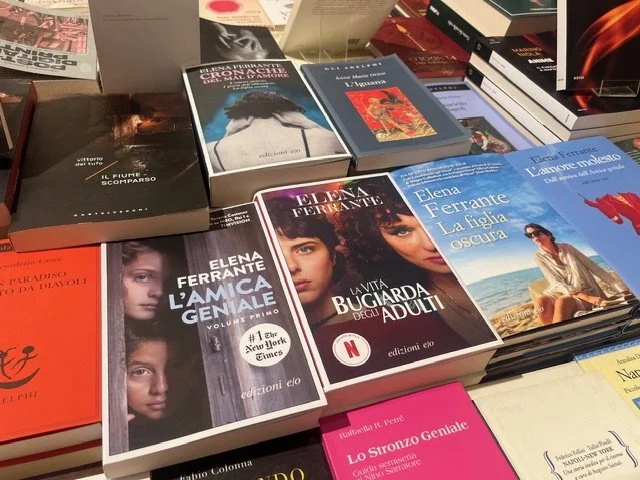
My husband and I are in Naples. We are there largely because I wanted to see where Lenu and Lila may have lived in My Brilliant Friend. We sit at an outdoor restaurant in what seems to be an alley. Motor scooters whiz by at startling speed, weaving among pedestrians carrying their food shopping. Graffiti of Maradona, the soccer star, covers most walls; garbage bags are piled high. Just up the block I can see shirts and sheets hanging on lines outside apartment windows. The waiters, who are young, look rough, all muscle and attitude. I smile a lot and try not to anger them with my broken Italian. “Scuzi,” I say, and “Grazie.” We order pizza, anticipating the best in the world.
I am from Queens, New York, and I consider myself a pizza connoisseur. Down Lefferts Boulevard was Dani’s House of Pizza, a mecca for me and my friends. We congregated there every chance we got. We had to sit at the counter for a slice and considered ourselves lucky if the skin on the rooves of our mouths didn’t come off on the first bite.
When I was 12, my mom hired someone to take care of the house and also, it turned out, to look after me. Giovanna was from Naples, and her English was heavily accented, with a singsong quality. She was 24 years old, my height, and thickset. She had no eyebrows. I asked her about her eyebrows as she settled her things into my brother’s room after he moved out. “I shave them,” she said, “like everybody in Napoli,” and she shrugged her shoulders, like what a stupid question. My eyebrows were thick and full and tended to connect in the middle if you looked carefully. She squinted at me as she lit up a cigarette and tossed the match in the ashtray which she must have swiped from the living room. Her eyes were green and seemed to be grinning at me.
After school she prepared me a salad of tomatoes and garlic accompanied by hunks of bread that I dipped in olive oil as she instructed and used to pick up the tomatoes. On my walk home, it was all I could think about. I never especially cared for tomatoes, or even garlic, but together with the oil and a little salt and squished into the doughy part of the bread, the thought of it made me walk faster.
“Tomorrow I will make you a pizza,” she would say.
The next day I’d call Dorian: “Giovanna is making pizza tonight.”
“Shit,” he’d say, and I knew he was coming over to eat with us.
We didn’t normally eat together. My older sister, Debi, and my dad ate when they got home from work. I rarely saw my mother eat as she had so many social outings. And Dorian was living in Jackson Heights. But when Giovanna made lasagna, pizza, or pasta, my family gathered, ushered to our round table by her, and we took our seats. “Mangia,” she would say, like a boss. The pizza was gleaming and I was salivating. The crust was both soft and crunchy, the mozzarella perfectly spotting the sauce, the aroma of warm bread permeating the kitchen.
Dorian flirted with Giovanna, and she flirted right back like I wasn’t there. He was two years older than her, and he was so cool-looking, with his wavy hair and his shirt open over a smooth muscular chest. Even my girlfriends fell in love with him.
When Dorian asked her where something was, maybe his bathing suit, or a belt, she would say, “Ma, I don’t know,” the annoyance clear in her tone.
“But it was right here,” he would say.
Then she’d look at me, as if I’d suddenly come into focus, and say, “Your brother,” slicing her hand through the air in a chopping motion, like he needed a good slap.
In August she brought me along when she went on vacation with her aunt for a week in the Catskills. My mom surely paid her extra to take me, maybe even paid for the accommodations. We went to Villa Moscona, a hotel in the mountains, the three of us in the same room. She spoke in Italian with her aunt so I wandered off a lot, played shuffleboard, and did handstands in the pool. One night the kids in the pool invited me to join them. We ordered pizza that tasted like cardboard, and we had a contest to see who could eat the most. I ate three slices and lost. The boys caught fat frogs and threw them into the air to watch them splat on the concrete near the pool. That is when I left to go back to our room and didn’t hang out with them again.
The next day I sat in the reception area in front of the TV. The floor I sat on was carpeted and the television was giant and looked like furniture. I was playing solitaire, the cards laid out between my splayed legs, and the news was on. Elvis Presley had died, and although I didn’t care for him, I knew the moment was important. I looked around the humid room with the orange-yellow carpeting and curtains so I could remember it, the way people remember where they were when Kennedy was shot.
A little while after that trip, money went missing. My dad used to empty his pockets of loose cash on his bureau. He put an invisible dye on the next wad of bills that would show up on whoever touched it. Giovanna’s hands were covered in blue ink, and I knew she was going to get fired. I saw her in my bathroom trying to scrub it off.
I don’t know where she went, or if she returned to Naples. I had never learned her last name.
Now in Naples, the pizza arrives, and I take the first bite, waiting to be transported. Instead, Giovanna floods my memories. I picture her walking down the narrow streets with a bag of groceries. Maybe she will look old and not have many teeth. Maybe she will be large and smoking. I fantasize that she will tap my shoulder and say, “Ma, Leslie, what are you doing here?”
I eat and eat, and with each bite I think, her pizza was better and what I would give to be at that round table in my parents’ kitchen, my brother elbowing in, my sister sneaking another piece, my father smoking with satisfaction, my mom saying, “Oh my god, this is delicious.” And Giovanna sitting with us, smiling generously, and saying, “Mangia.”
Artist Statement
I always thought of pizza as a NYC kind of thing, like a hotdog or a burger. That was, until Giovanna came into my life and moved in with my family in the late 1970s. She came from Napoli, and the Italian pizza she made for us was so different and exquisite, a completely sensorial experience. We only ate together as a family when we had out-of-town guests and for holidays or birthdays, but when Giovanna cooked a meal, we were all present. Decades passed. I forgot about her, never even mentioning her to my husband of 30 years. I booked a trip to Naples with Lenu and Lila in mind. Naples is a fascinating,
chaotic, and authentic city. We went to a restaurant in the old part of town and waited for pizza to arrive at our table, expecting something otherworldly. What I got instead were precious memories of Giovanna and being back at my family home with my parents and siblings. If only I knew how to find her in a city of Giovannas.
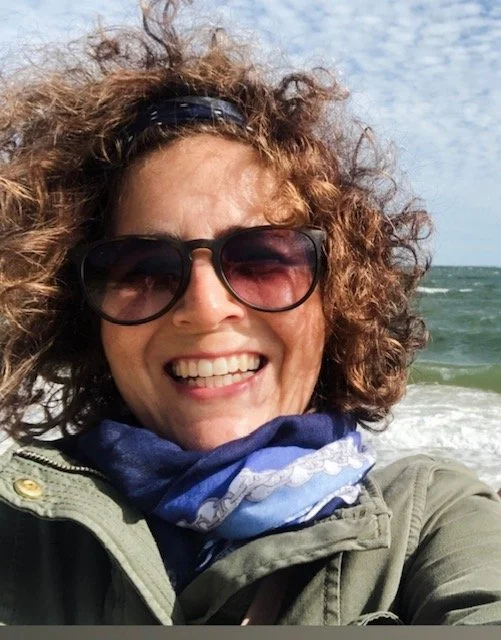
Leslie Lisbona was featured in the Style section of The New York Times. She is the winner of the creative nonfiction prize at Bar Bar Magazine and has been nominated for Sundress Publications Best of the Net. Her work has been published in various journals and magazines such as Synchronized Chaos, JMWW, Smoky Blue Literary & Arts Magazine, and Welter. “Mangia’”is her second essay published by MicroLit.