
“Poetry Wants Us to Be Our Free and Best Selves”: Carlene Gadapee’s reflection on Ada Limón’s Against Breaking: On the Power of Poetry
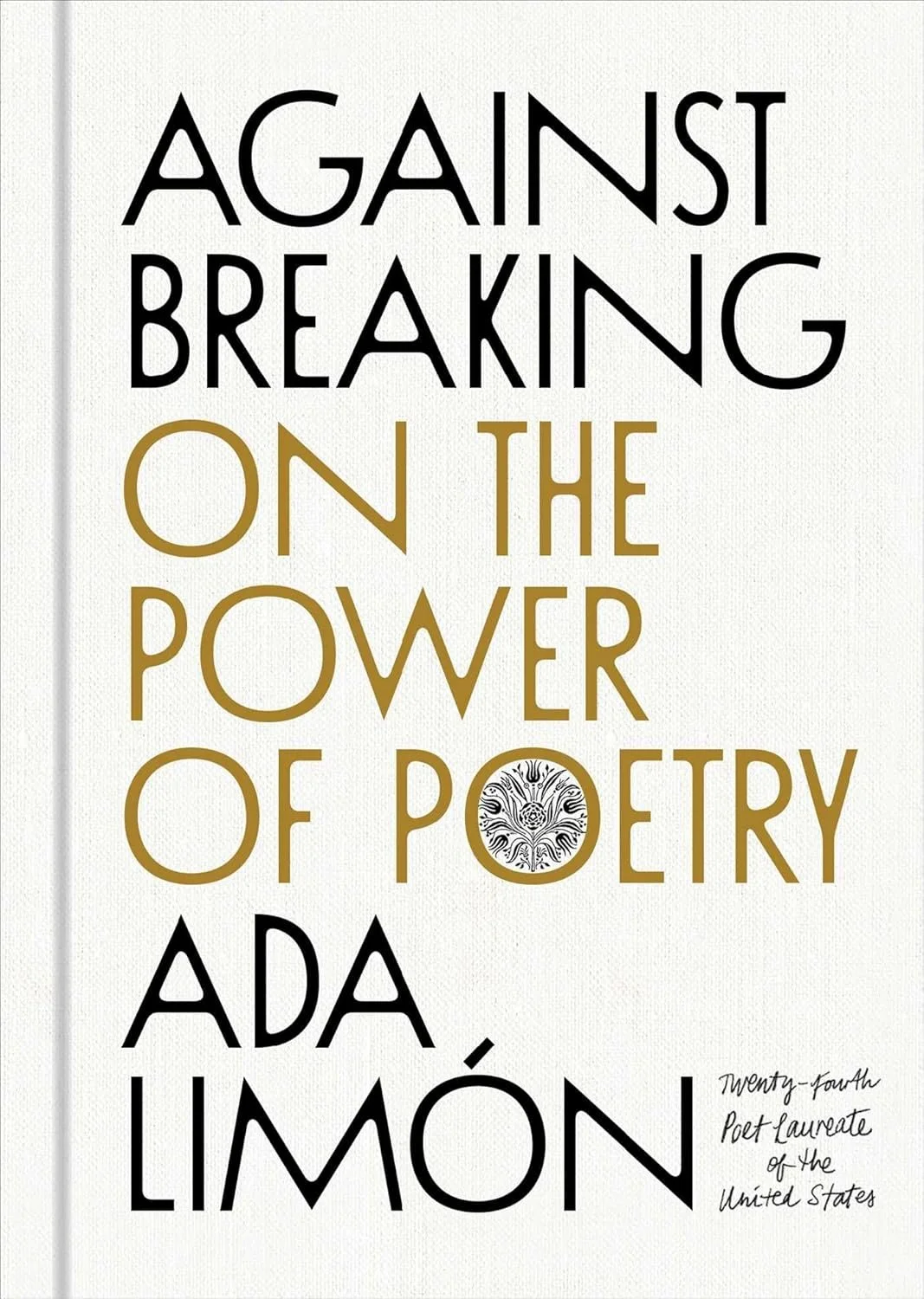
Against Breaking: On the Power of Poetry Ada Limón, Twenty-fourth Poet Laureate of the United States
Simon and Schuster, 2026
56 pp.
Ada Limón’s Against Breaking is a love letter to language and poetry, and, by extension, to us all. The slim volume is the print version of her closing lecture at the Library of Congress which she delivered on April 17, 2025. What it is, for the rest of us, is something far more: it is a necessary call to not only make a case of poetry as an art form, but it is also a cry for help, for and from us all in this age fraught with so much division, climate crises, and the unhappy state of things for so many people around the nation and the globe.
Normally, when I write a review and discussion of a work of literature, I try to stay close to the page and not offer too much from my own thoughts. In this case, though, I feel like this essay is going to be more of an op/ed piece. Full disclosure: I am a high school English teacher and I am a poet. Both are good enough reasons for me to heed Limón’s lecture. I have witnessed first-hand for decades the erosion of empathy and the sense of isolation and hopelessness in our young people. There are myriad reasons, part social, part global emergency, and part the insularity of digital distractions. They are hyperconnected yet completely isolated, which is an interesting and somewhat frightening conundrum. What can we –I-- do about it? I dictate poems to them at the start of almost every class, and we talk about the structure, the craft, and then, the poet’s intent and how the poem affects them as readers. I have them read fiction and personal essays by established authors. I insist on conversations more than quizzes and I want them to dive deeply into the exigence that prompted the writing that they are looking at. I’m fond of saying that “the date changes, but people don’t”—meaning, of course, that the same concerns, at the root, have troubled mankind since the beginning of time. How we grapple with those concerns and our response to them is the fundamental impetus behind all writing.
Limón’s lecture points us toward one way to confront the contemporary concerns we have, and she reaches back to and into poetry to describe a path forward. In the Foreword, Limón outlines the way she developed her Laureate project. She listened. A lot. She talked with everyday people, with tribal elders, with other writers and thinkers. It became evident that there is a convergence between the environment and poetry, and that poetry may be one way to bring more people to care about what is happening to our only home. With this lecture, she invites all of us into the conversation and creates a vision of the “large room we all must create together, the room where we all must work hard to save what matters.”
So what matters? And how does Limón find, as she puts it, “clarity” in all the confusion and noise that surrounds us? She says that if she sits quietly enough, then poetry “start[s] to move through [her]” and it comes “as if through a necessary beckoning.” And she’s not the only poet who has spoken about the saving nature of poetry. In her memoir Inside the Halo and Beyond, Maxine Kumin speaks passionately about how poetry kept her mind from spinning out of control while she was in a medical halo, recovering from a near-fatal accident. And it’s true, at least for me, that poetry gives us words we can borrow when the unspeakable happens. I was teaching a class when 9/11 happened. We all had to watch the morning news show that was produced for high schoolers called Channel One News, and while we were sort of keeping an eye on the screen, the announcers cut to video feed of the planes hitting the towers. We were all dumbstruck, thinking at first it was a horrible pilot error, but then, we soon knew that it was something much, much more sinister. My brain went blank for a moment, then the final stanza of Matthew Arnold’s “Dover Beach” started running through my head on a repeated loop. It didn’t give me comfort so much as it gave me words for the horror and fear I was feeling. A poet had felt like this before, had put words on the page, and they were there for me. I’m grateful.
In her lecture, Limón tells about her own reaction to 9/11: she turned to Adam Zagajewski’s “Try to Praise the Mutilated World” (another of my favorites as well), which she recalls reading in The New Yorker the week after the towers fell. She says that “[f]or weeks afterward, that poem was passed from hand to hand, read, and shared. That poem was the only thing that made sense…it reminded me that language had power.” As Limón puts it, “we are never alone…because everyone who has ever written is with us.” There’s a resonance in her words of John Donne’s Meditation XVII, in which he states, “all mankind is of one author, and is one volume; when one man dies, one chapter is not torn out of the book, but translated into a better language…and [God’s] hand shall bind up all our scattered leaves again for that library where every book shall lie open to one another.” We are never alone; we just have to know where and how to look.
We are not alone, not in our joys but also in our fears. Limón tells us that people are “hungry for poetry, language, and connection” and that “it already serves as a much-needed lifeline.” Poetry is a common language of a sort, and it is one of the first art forms known to mankind. She goes on to say that poetry has a “secret power,” that it is made up of “[l]ittle engines of sound, urging us on, telling us we are not alone, because we can’t be, we are connected to the readers and writers of poetry.” Even if we are closet poets, does that even matter? Just because something we write might not find a home in the published sphere, it still has its own magic. Putting feelings into words, and putting those down on the page or the screen (though I think there’s much value to putting things in one’s own handwriting—a topic for another day), is not only useful, it is also important. Limón explains that poetry has another “secret power” as well; it “makes room for how utterly different we all are. It has no interest in sameness, flatness, homogeneity, and yet it is deeply human and can be, at time, universal.” We are unique creations, and we have the ability to create: isn’t that essentially what makes us both human and humane? We are not, as she says, machines. Limón addresses the rise of AI and its limitations; chiefly, AI has no soul. Only humans can truly create art in any form.
Poetry makes us vulnerable. She says that “at the end of the day, [we are] deep feelers. And if we can admit our feelings, then we might be able to move in the world with more equanimity and courage.” Writing is an act of courage; we are all so mindful (maybe even fearful) of being judged for what we say, and if we put it on the page for others to read and react to, then we risk being open to criticism. People often say that it’s just words, no one is bleeding. But yet, we do bleed a little when our words don’t find the mark. And we bleed a little when they do. Poetry seeks to make connections, not just find approval. And sometimes those connections are painful ones. That’s human, “oddly intimate,” and poetry gives us permission and a means by which to explore and to question our own experiences as they are reflected in someone else’s words. Limón says that “[p]erhaps, in dire and dangerous times like these, all poetry can do is remind us where courage comes from.”
And we all need a reminder, don’t we? The gushing firehose of “news” can leave us confused, breathless, and despairing. But then, we can find that our confusion and need for understanding is already being addressed. Keats, in “When I Have Fears,” tells us that we must and can confront the hard stuff over and over again, that acceptance is not really surrender, but a daily practice. Where else can we find those words? Facing death and loss is a deeply upsetting thing, and Keats paves the way. Poetry paves the way. We just need to find the right poems.
Limón says that we need a “secular sacred language” and that poetry just might be it, because it has “the power to form connections, foster courage, and refuel us for what’s coming.” In her Laureate project, “You Are Here,” Limón not only listened as she formed the ideas that became the finished work, she also insisted on the healing nature of poetry in public spaces. She and her team put poetry in all the National Parks, because they felt that “poems might help us do one simple thing: Pay Closer Attention.” She believes that an “accidental encounter with a poem can bring you back into the world, can remind you that you are in the world, part of it” and “language in these public spaces matters.” Poems in nature, poems on subways, poems on the sides of buses, anywhere and everywhere, can give us a moment to pause and connect with the space itself and with ourselves in it. During April, for National Poetry Month, I have my students take a couple dozen selected poems that I’ve made copies of and put on brightly colored paper and they tape them up outside various teachers’ doors, outside the lunchroom and the library, on the office door—everywhere people might encounter them. Most of the poems stay up for the remainder of the school year, if not longer. One teacher friend of mine said of the poem the students posted outside of her classroom, “I feel seen.” Isn’t that what poems in public places can do? Should do? As I said, in this hyperconnected world of ours, very few of us really feel seen; we are behind screens of various sizes, and rarely do we get the opportunity to sit and talk deeply and honestly with another person. Poetry can give us the necessary breathing space, the pause, that our inner selves desperately crave.
Limón says that “poetry is powerful in part because it exists in the questions and holds no answers…it’s an interrogation of the world and one’s place within in.” From an earlier generation, Rainer Maria Rilke says, “Don’t search for the answers, which could not be given to you now, because you would not be able to live them. And the point is to live everything. Live the questions now. Perhaps then, someday far in the future, you will gradually, without even noticing it, live your way into the answer.” Whatever our questions are, poetry may be a map for finding our answers. See? The poets agree, across time and space. Who am I to question their wisdom? Limón goes on to say that poetry is also “a natural caretaker of the small life” and that we cannot “rise to our full power if we are not paying attention to what we give our attention to.” She also says that poetry offers us possibility with all the “what if” questions. Indeed, what if? Paying attention and engaging in the wondering is a means by which we can offer our thanks to the poets who have come before us, to the world as it was, is, and can be. She says that “[w]hen you want to create a safe space to stand in, breathe in, to gather courage, to find your hope again, to find your strength again, you can stand in poetry… poetry wants us to be our free and best selves, open to wonder and open to making a life that matters—both big and small.”

Poet and English teacher Carlene M. Gadapee lives in northern New Hampshire with her husband, several fruit trees, and two beehives. Her new chapbook, Relearning the Body (Finishing Line Press, 2026) joins her first one, What to Keep (Finishing Line Press, 2025), and poems and reviews in journals such as Allium, Smoky Quartz, Touchstone, Gyroscope Review, Vox Populi, and MicroLit.