
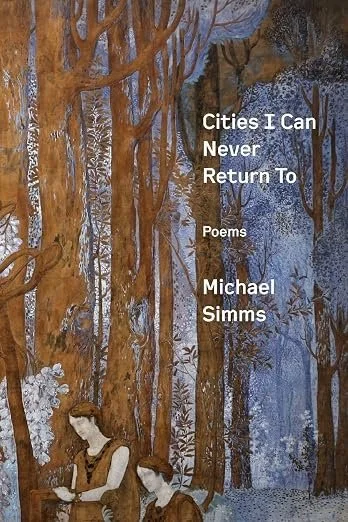
Cities I Can Never Return To
Michael Simms
Ragged Sky Press (2026)
90 pages
After reading Michael Simms’ new poetry book, I was convinced his title, Cities I Can Never Return To, is perfect. What of the past can we go back to except through memory and story, which is what this writer does so well. And in that memory, in those cities, he “recalls heat rising from warm fields of bitter lemon mixed with the smell of carrion flower,” which is to say his stories mix with the beautiful and the lamentable, like the nasty smell of carrion. He holds nothing back. His poems are filled with court houses, cane back by the Bayou, postcards of public lynchings, “sorry souls,” and diners in New York City where “white men on heroin blow long questioning notes.” He admits being part of the world’s evil as he stands by a policeman beating a black man without doing anything.
His life leading up to becoming the poet he was meant to be, was filled with pain, real and raw. He writes often of his dad who was not the kindest of men. That influence leads Simms to spend years “in the urn of grief” as he drinks with friends all night in a cemetery or meets up with women he will never recall. The poems fill with these memories as he brings “up the past and chews on it again.” At a picnic before he knew about “the poetry of steers,” he collects trash and “throws bones on the fire.” It’s a wonderful metaphor for this book of poems.
What I love is how he uses place and time in titles to give readers direction. As he travels through Texas and Pittsburgh and other places he begs to call home, his fabulous visual details paint pictures, like the time he measured his sorrow with a brown paper sack or stole jars of baby food from the convalescent Center where he worked. The nine people he’s in charge of can never be forgotten—“last in line their entire lives,” as they “roll their blind eyes in their sockets.” He wheels them into the rec room where they will be fed pureed green beans and chicken puree every day. Outside that world, “death was the man on the corner.”
Sound also enters these poems, like the night he hears a muted trumpet and the piano keys from a club, then recalls the “pushing slow notes of Chet” into the air. His loneliness is palpable. If only, he writes, he had known that “these were the last days of the empire,” he would have chosen kindness vs. pity, and desire over desperation. Slowly he feels his way “through the ruins in this “end-of-the-century shadows” when a “slanting rain begins to fall.” You can feel the rain washing away his despondency as a cargo of possibilities arrives and some old parts of life depart. At some point in Dallas, he confesses that he questioned kindness with suspicion. His drinking buddy matched him “ache to ache.” He knew then, “I needed to change or die.”
It would take him years “for me to become me,” which by poetic nature is a hopeful statement. Simms is not afraid of finding words for our possible future where “the white facades discard” and “death is an arrival we don’t understand yet.” Reading these poems slowly, one comes to see his brilliant use of language, subtle sometimes like his use of green as a metaphor for an estuary flowing into the light. Here “the tide meets the stars like a discharge of memory.” It’s his very goal here.
The thing with memory, he admits, “it keeps coming back” like the morning glories he writes about. “Even the grain of wood in a table “reveals its history as a tree. Every stone has a story.” It’s these stories I love. It’s like reading a narrative of a life, in other words, a poetic memoir. He has not walked away from life’s pain but instead sucked on it like those peppermints his grandfather used to enjoy slowly. At his father’s deathbed, there is an “I’m sorry” moment and he realized he himself, like his father, had searched for years for a home within himself, a comfort “he so longed for.” In the end he comes to see how he, like his father, didn’t get what he wanted or needed, but got “what we got.”
Man can easily “descend into darkness,” but these poems are like the river Simms finds after being “in love with unhappiness.” He learns he has been able to survive looking out to the horizon and searching through nature. He pours his parents’ ashes into that river. There’s plenty of blame here and lots of forgiveness; but it’s his deep and big-hearted humanity alongside his vivid storytelling that takes us through despair and hope. I loved reading it all.
He leaves us with hope and true understanding: “Really my imaginary friend, it’s all about sitting still and letting the touch of a breeze reassure you because we hold these bodies only a short while before moving on.”
“Poetry itself is a becoming,” he writes. “Like love, a poem requires losing yourself, opening a space large enough to receive the reconciliation of grief and laughter, “pale haze on a bleak sky.” No wonder his poetry has been translated into four other languages, and he was awarded a “Certificate of Recognition” for his service to the arts. I highly recommend reading Michael Simms.
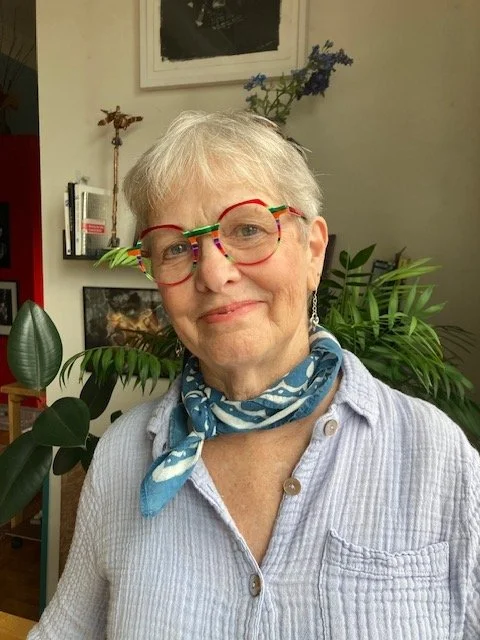
Gail Hosking’s writing has been anthologized and published in many literary journals. She is the author of the memoir Snake’s Daughter: The Roads in and out of War, as well as two books of poems, Adieu and Retrieval. She was a finalist for the Center for Book Arts Chapbook contest, a finalist for Iowa Review’s creative non-fiction contest, a semi-finalist for “Discover the Nation” poetry prize, finalist for the Autum House Press NF book contest, finalist for River Teeth CNF book contest, and the recent winner of the Permafrost Nonfiction prize for 2026 with her essay collection Dispatches From a Distance. Two of her essays were considered “most notable” in Best American Essays. Her latest memoir, No Glory is forthcoming, December, 2026. She holds an MFA from Bennington College. www.gailhosking.org