
A Particular Kind of Heartbreak: a review of Laurel Saville’s HOW TO LIVE WITH A DOG by Rebecca Brock
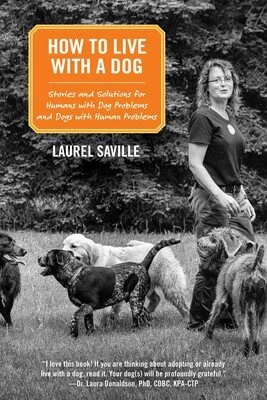
How to Live with a Dog
By Laurel Saville
Urano Publishing, 2026
256 pages
Working with dogs is messy. For that matter, being human is messy. Laurel Saville hadn’t intended to become a dog trainer—and several of her clients say that she is “not a dog trainer but a human trainer.” Saville’s own journey in life has taken unexpected turns, met with road closures, landslides, the destination changing sometimes suddenly, sometimes without warning, and often through no fault of her own. After enduring change that would shake the most grounded among us, including a cross-country move, the death of her beloved dogs, a divorce and an early onset life-altering medical diagnosis, Saville found herself in the “strange and eerie quiet this much loss leaves behind.” She began filling her days working with rescue dogs at the local shelter and discovered she had a particular “knack” for working with the reactive or troubled ones. This work saved lives—giving dogs a chance to find their humans, and humans a chance to keep their dog. Several certifications, much research and many years later, we have How to Live with a Dog—a book about dogs, yes, and how to live with them, but, thanks to Saville’s deep clarity, compassion, and engaging storytelling—it’s also very much a book about how to human.
If you have ever loved someone—be it human or animal—through a difficult time, this book might be a sort of balm. Saville’s decision to fill the “strange and eerie quiet” that so much loss leaves behind by volunteering with animals makes sense to me on a visceral level. When my oldest child was entering adolescence, he struggled with health and mental health issues all within the yawning backdrop and social void left by the Covid19 pandemic. He had gone silent and distant, semi-frozen in his own place of fear, anxiety, and trauma. People were too much and too hard. My last ditch, big idea was to sign us both up to volunteer at our local animal shelter. My kid loved dogs, and dogs were often drawn to him.
There is a particular kind of heartbreak that sets in when, for whatever reason, and there are so many possible reasons, you fail someone you love. You’ll try everything you can think of with the hope that it might help. Saville writes that, often, paying attention is the first requirement of loving, and living well, with another creature. Throughout the book, Saville engages the reader with humorous and heartfelt stories about her clients, and their dogs, showing us how immovable things might shift when we are finally brave enough to name what is actually happening. In “How to Play Fetch” Saville introduces us to one client and his dog, H. The client is desperate for the dog to play fetch, to reliably return the ball. After watching the attempts and misfires between the overexcited dog and the frustrated human, Saville offers the simplest command to her client: “don’t throw.” What follows is a remarkable interaction that eventually, and quite quickly, allows them both to play the game—the human learning to wait and allow the dog room enough to choose his response. Later, Saville writes of the dog choosing to rest for a moment in the midst of the game: “H. was not being disobedient. He was being a sentient creature taking care of his own needs while staying present in the interaction with his friend.” In stories like this one, Saville offers proof of the weary strength that comes with setting down expectations, in a crisis, and seeing what we have at hand. She shows us how to stay rooted in a deep awareness of the actual dog—not the idea of a dog, or someone else’s idea of the dog, but the particular, actual dog in front of you.
Saville is a narrator we trust because she is honest, and vulnerable, and not afraid to address hard things. In the final chapter of the book, we finally, officially meet Willow, the Wonder Dog, a buoyant character who has already made several appearances. This final chapter shares Willow and Saville’s origin story—Saville first meeting Willow at the crux of her heartbreak when she was decidedly NOT looking for another dog and Willow, stuck in a shelter, the unwitting victim in a human cruelty case. What develops between woman and dog is not just deep companionship but caretaking, reciprocal and endearing. Willow takes on the role akin to what a highly trained service dog might not be able to achieve and Saville, in spite of everything she’s endured, meets Willow’s “well…what are we up to next” gaze with love, adventure, and connection.
“Sometimes,” Saville writes, “the best thing for everyone is for the human to stop trying so hard. Sometimes, this is the hardest thing of all to do.” As a reader, and a mother, this line stopped me, and I had to set the book down and let myself have a little cry not of pity but tenderness for the mom that I was when my kid was struggling, for all I’d tried to carry and to hold for him, for how much harder I, inadvertently, made everything. In the end, my kiddo needed me. Not me trying to do or control or fix or teach—just me, beside him, letting him figure out how he was going to start moving again and giving him a safe space to do that. For us, the shelter, the dogs we worked with, and the shelter staff, embodied resilience, and acceptance. Working with those dogs did more for my kiddo’s mental health than anything else we tried and I had tried, we had tried, so many things, for so long.
“When a dog reacts, he goes “over threshold,” or out of his thinking and learning mind and into an automatic, instinctual, reaction mode,” Saville writes, “it’s like a nice guy getting in a bar fight. Or a toddler having a meltdown. Any animal over threshold can’t hear, can’t take in new information, can’t learn.” Saville suggests that giving dogs, and their humans, the time and space needed to calm themselves down, to deal with their fear, or reactivity, not because you distract or control or yell at them, but because you are beside them, offering reassurance and presence. When my son was around four years old, he’d had a huge meltdown in a public place and I’d known enough to get us both out of there but I hadn’t learned yet, and wouldn’t for several years, to let him, or help him, settle his nervous system—instead I stumbled headfirst into making the whole thing harder on both of us: lecturing and explaining and, finally, asking him who was in charge here? When his fat little hand pointed at his own chest it made me laugh—but truly, he knew more than me. Years after our time at the shelter together, I found myself writing a poem about my son—referencing William Ernest Henley’s “Invictus”, I called it, “Unconquerable”. In it I recognize how my kiddo, even at a young age, was already “a tiny captain of his soul.” This has continued to prove true as he makes his way in the wider world, writing and playing music that moves me to utter stillness and gratitude for our continued and deep connection.
It's so easy to recommend this book—we’ve got dogs, we’ve got humans, we’ve got sorrow and antics and joy—mishap and triumph—compassion and grief, the whole width and breadth of what it means to love, to be bound to a being other than yourself. Saville’s book offers story after story of radical compassion and radical acceptance—reading it just might change everything, even your life.

Rebecca Brock’s work appears in The Threepenny Review, CALYX, New Ohio Review, Radar Poetry, The Shore and elsewhere. A MacDowell Fellow, her awards include the Lascaux Poetry Prize, the Atlantis Award, The Comstock Review's Muriel Craft Bailey Memorial Poetry Contest and the Kelsay Book’s Woman’s Poetry Prize, among others. She holds an MFA from the Bennington Writing Seminars and she is the author of The Way Land Breaks (Sheila-Na-Gig Editions 2023). Find more at www.rebeccabrock.org.