
“There is A War in My Homeland”: HUTSULKA by Nicole Yurcaba, reviewed by Andria Williams
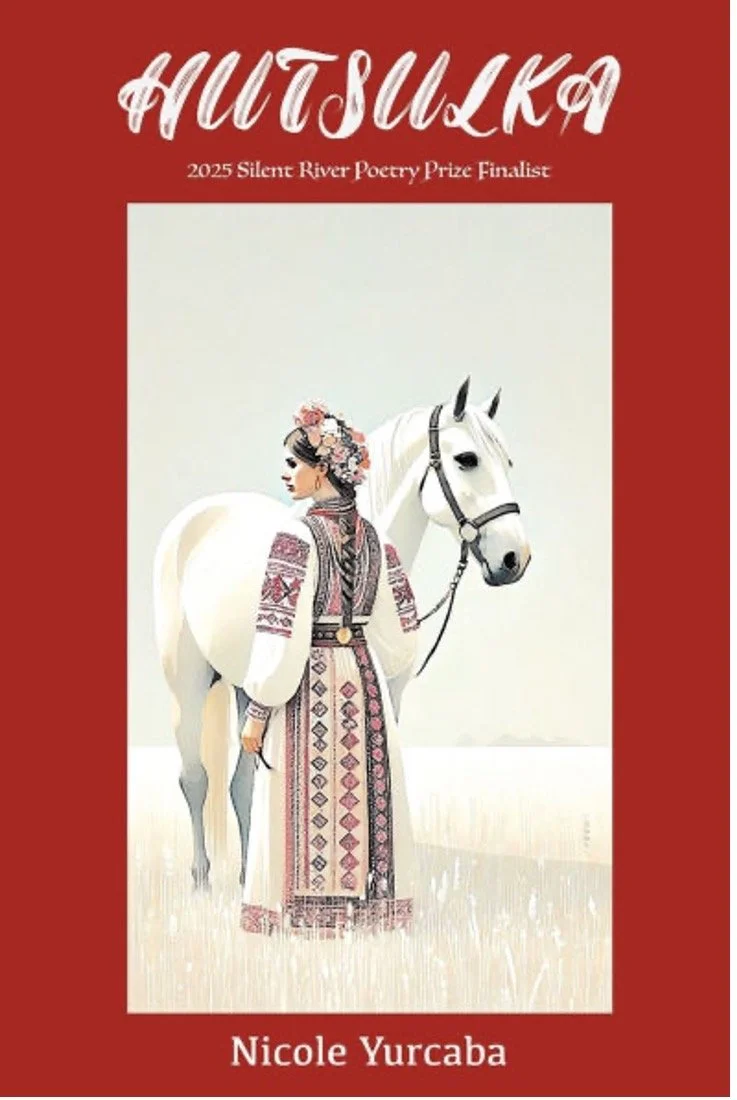
Hutsulka
by Nicole Yurcaba
River Paw Press, 2026
36 pages
Hutsulka, the newest collection of poetry from Ukrainian-American writer Nicole Yurcaba, brings the violence of war head-to-head with the tensions between men and women. Relationships can fail, these poems say, just as war is the ultimate failure of imagination.
These are riveting, sensual, almost hypnotic poems. Most are a page or less, with a disciplined, precise rhythm. That discipline is rather inventively thrown aside, however, when it comes to the titles:
“Ode to a Man Who Will Not Date Me Because I Do Not Look Like an American Supermodel”
“Ode to a Former Lover Who Impregnated His Ex-Wife While We Were Dating”
“Ode to a US Army Special Forces Soldier Educating Me about My Homeland’s Literature”
“Ode to a Man Who Says He Cannot See Me”
“Ode to a Man Who Makes Me Feel Small and Pathetic”
“There is a war in my homeland,” the poet writes — this line is woven many times throughout the collection — but there is also a war in her heart. Most of the poems are written to an unnamed “you,” which adds an intimacy that can come across as beautiful, or flinty, or sometimes even violent. These are accusatory poems. The “you” is generally about to get his ass handed to him.
Roughly two-thirds of the poems are about failed or frustrating relationships with men, usually involving deceit and betrayal on their part. Meanwhile, she feels her homeland is also being betrayed. The line is often blurred:
I stopped believing in revision long ago, so come closer:
my paternal grandfather stared through a displaced persons camp’s barbed wire;
my maternal grandfather shrank into himself in Dachau;
Operation Vistula flushed the syllables my English hides from Poland.
Allow me to drive your pick-up truck straight into the local convenience store’s gas pumps.
Allow me to piss on the stars-and-bars that designate your hate.
You tread on me, not knowing I hide underground,
operating radios, sending coded messages regarding your whereabouts & insurrections.
Lean closer, Southern son.
I want to see the red on your neck.
(from “Ode to a Virginian Man Who Tells My Homeland to Go Fuck Itself”)
Or this, from “Ode to a Man Who Wants Me to Carry the Weight of the War “
in my homeland in silence.
You say you cannot speak to me.
You say, Two sides exist in every headline, social media post, meme,
joke.
Over salami & cheese, I mention an illegal use of incendiary bombs. You tell me my president siphons money from the billions sent by the US government.
I tell you, Shut up. Read a fucking book. I wonder how,
when you hate my homeland so much you can even tolerate me. Perhaps you don’t, secretly.
Perhaps you fantasize about strangling me
while I sleep beside you, our cats nestled between us.
I don’t love you anymore. I haven’t in seven years.
I stay only because you owe me fifteen-hundred dollars.
Other poems deliver this tension between lover/homeland in a slightly softer way, as when one of the poet’s boyfriends continues to listen to Shostakovich three days after the Russian invasion, which she considers a betrayal. They agree to “decolonize their (s)helves.” But most of the men portrayed in Hutsulka are self-centered and arrogant, sometimes even ignorant (do I dare use the word “pricks?”); their modus operandi is lying and deceit. Yurcaba believes they cannot understand her, just as Americans cannot understand her homeland. The aggression of both is an occupying force; they are Russia and she is Ukraine.
The accusatory nature of the poems can sometimes feel one-sided; the relationship mistakes, for example, are all, without exception, committed by the men. But Yurcaba is suffering greatly from a war that has killed people she’s known. The poems often display equal parts sadness, disgust, and utter frustration. She counts each day of the war as she digs for fossils in Wyoming. She frets, understandably, over text messages from her cousin back home.
But there are moments of genuine love and affection, as in the “Orchard Keeper” poems. We never find out who this orchard keeper is, but the poems are written with a sensual tenderness and a genuine longing for the war to be over, to be free from it even as she is devastated by it. Again, she transmutes that longing into the persona of a man:
Knowing you touched each apple, I eat them slowly:
skin tight against my teeth
taking you inside me
bite by bite
And, in perhaps the loveliest of them all:
The air smells
Of creeping black ants, dehydrated black snakes,
and Type O Negative songs. There is a war in my homeland.
…with you, I leave the war behind.
…with you, I return to my childhood’s language –
sanctity and prayer and catechism and ritual -
oh, holiness -
Oh, dying syllables –
Oh, divine exorcism at my weakest hour -
Oh, you –
***
The collection can be ordered here. The press is offering a pre-order discount.
About the author:
Nicole Yurcaba is a Ukrainian-American author of Hutsul/Lemko origin. Her poems have appeared in Appalachian Heritage, Atlanta Review, Poetry Island Review, and many other publications. She is the author of The Pale Goth (Alien Buddha Press, 2023) and the chapbook Have Your Eyes (Dancing Girl Press, 2025).
Andria Williams is the author of the novels The Longest Night and The Waiting World. She lives in Colorado.