
“Sudden Bends”: a review of Carol Parris Krauss’ MOUNTAIN. MEMORY. MARSH by Gail Hosking
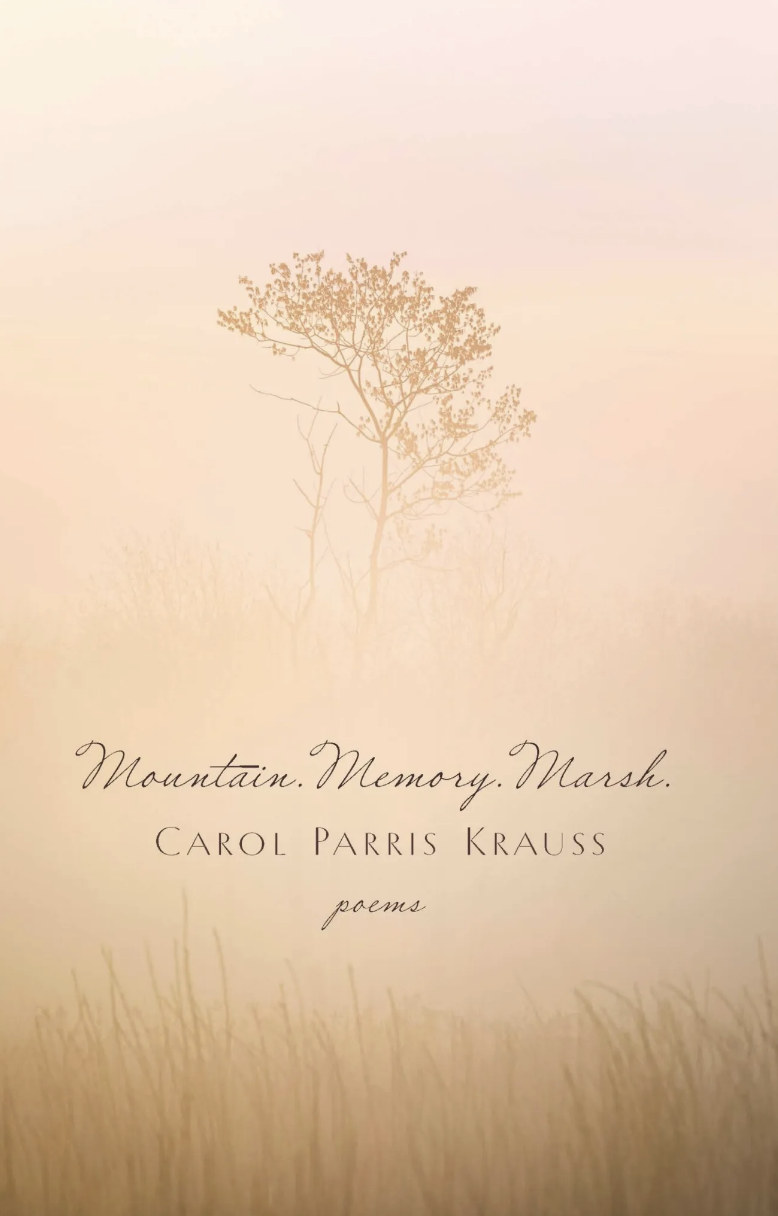
Mountain. Memory. Marsh
Carol Parris Krauss
Fernwood Press (November 2025)
It’s understandable why Carol Parris Krauss is the University of Virginia’s “Best New Poet.” Her lyrical language with sights, sounds and color is a pleasure to read. Her memories and descriptions are alive on every page. She comes from a long line of storytellers and has lots to recall, “what you fail to see from your kitchen window.” In this collection, she takes us along to past places she has known, from old farmhouses to George Pickett’s Civil War tombstone. She includes dismal swamps, old iron beds with no room for a lover, “rickety railings, cobbled china, a parched pond, and apples picked during Covid. Mothers on their knees clean and polish old wooden floors like a ritual. “Each slab of timber will listen to you,” she writes.
She tells us what she knows and what she doesn’t know. Her memory, as she says, can slide her “into many of the slots.” The characters are illustrious and immortal, like Cousin Stan who steals cookies from her father’s funeral reception. Her daughter, “with bones of the wind.” Fairies she imagines in the attic with their “wings against the rafters and twitter of their laughter.” She includes her mother slowly going blind, her grandfather lining up the bottles he drank from on the windowsill, the loss of a duck’s mate, the ugliness of prison, and how important place is. Place and her strong visual imagery reveal emotions, whether it’s love, loss, or laughter.
In her description of family, she is a witness to the past as well as a storyteller with wisdom and a cache of delightful recollections. She is compassionate as she takes us through time and people growing old. “They say,” and “She says” are repeated so that no one is left out. Her metaphors might use fabrics to describe a family member, like corduroy for her sister, “cords of corduroy discontent”; and her mother, “sensible calico.” Her father, “rough burlap.” Or she will disclose damage to the land as a metaphor for the decline of certain people. Her creativity with language and strong images says so much in a new and interesting way, and in doing so, forces us to pay attention to our own lives. Her pace is perfect with a sudden bend to surprise us.
Her place is Virginia – its rivers, people, snapshots, sounds and “family treasures.” The stories are “penned in the sky” with hurricanes, tides, and hikers lost in the woods. Krauss has proved her storytelling ability, her delicious way with words, and the unexpected twist with language. No wonder she has been honored for her work in contests as well as writers’ competitions. She is worth reading and knows her craft well.

Gail Hosking is the author of the memoir Snake's Daughter, and two poetry collections, Retrieval and Adieu. Her essays and poems have been published in such places as South Dakota Review, Upstreet, Lillith Magazine, Consequence Magazine, and Nimrod International. Several pieces have been anthologized, and she’s received a few Pushcart nominations, and twice, "Most Notable" in Best American Essays. Recently, she was a finalist in the Autumn House Press book contest. Gail holds an MFA from Bennington Writing Seminars and she taught at Rochester Institute of Technology. Forthcoming in the fall 2026 is another memoir: No Glory: A Military Family's Reckoning (Kentucky University Press).