
“We Could All Learn”: Carol Parris Krauss’ Review of RELEARNING THE BODY by Carlene Gadapee
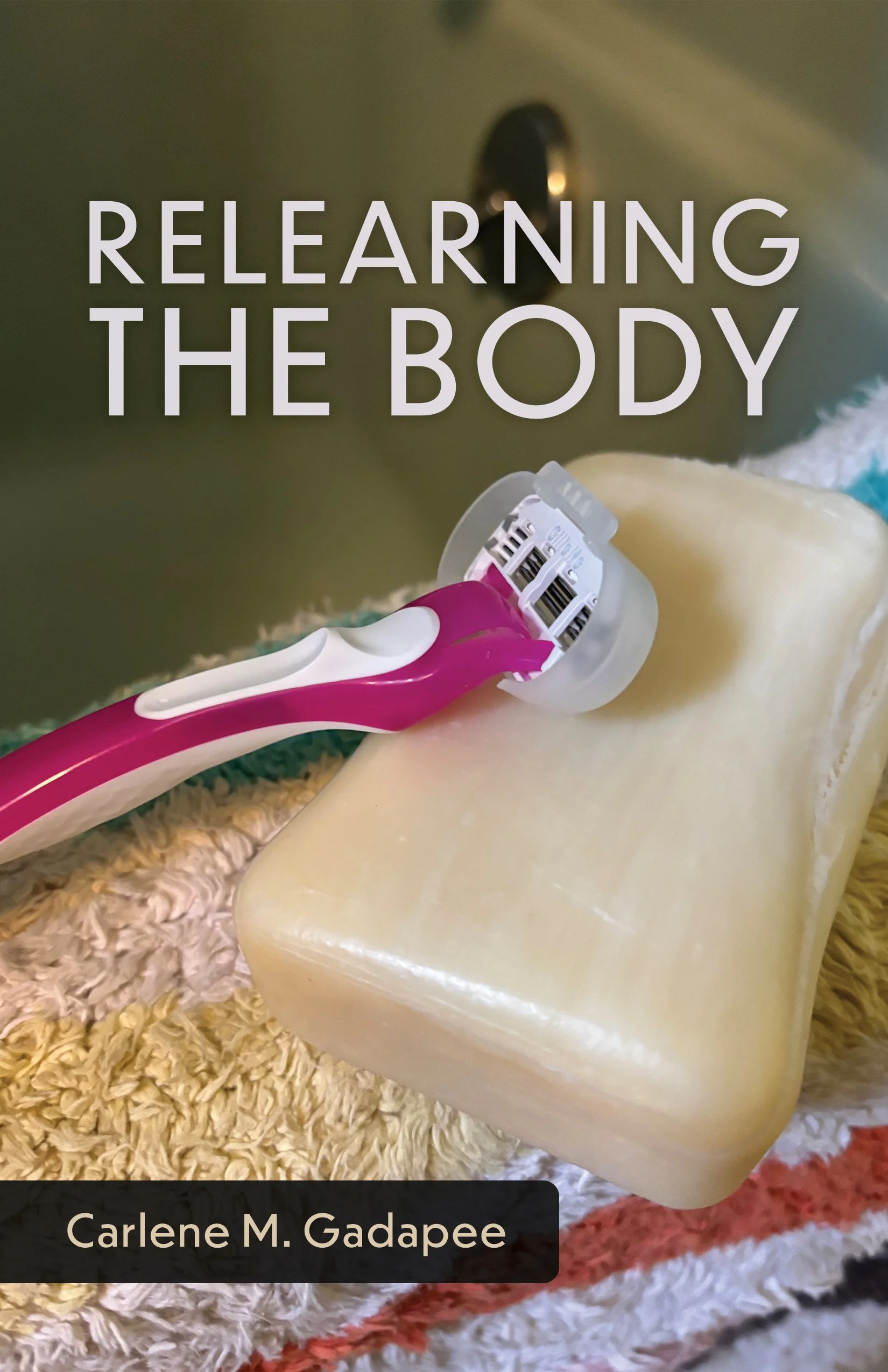
Relearning the Body
Carlene M. Gadapee
Finishing Line Press (May 2026)
34 Pages
Carlene M. Gadapee's second chapbook with Finishing Line Press, Relearning the Body, takes the reader on a field trip of rediscovery—one that speaks to anyone navigating the ever-shifting terrain of aging, memory, and self. The collection is a lyrical journey that moves between carefree humor and moments of survival, rediscovery, and small victories. What makes Gadapee's work so accessible is her ability to weave imagery, allusion, and a myriad of literary devices seamlessly into this journey, creating a mirror in which readers of any age can see their own stories reflected and rediscovered.
Her opening poem, "Seven," slowly strolls down memory lane, taking us to a carefree time: "a happy girl/in denim overalls/on a rusty/swing-set, braids flying." A time when one cared less about the contours and changing terrain of the body, and more about flying as high as possible, trying "to touch the sky." The precise visual and auditory language invites readers to stand back and watch that young girl—and perhaps remember their own moments reaching for the sky, pumping the swing as high as it would go.
The collection balances poetic reflection with humor and brutal honesty. In "Dinner," a four-year-old girl sits at the table, staring into the gray, watery stew,/broth grown cold and thin, carrots and mushy/green beans, pale onions flaccid in the murky,/shallow bowl.” She squirms while battling her mother (who ultimatley gives her an out), the stew, and her desire to "get down, get ready for bed." This warm, familiar snapshot is followed by the gritty mortification of "After-the-Party Villanelle," which examines the speaker’s parents' behavior—her father tending to everyone but her mother and her, her mother acting like a "drunken whore." And maybe she is too?
As you continue through Gadapee's collection, you'll encounter St. Thomas, Jane Eyre, and Circe. The poet masterfully weaves these allusions into the poems' emotional landscape, making them feel not like literary flourishes but as lived companions on the journey. In "Faithful," the third piece in "Homecoming," Athena glides in to speak "of truth, of oaths broken and debts/to pay,” while Odysseus longs for his forbidden home and Penelope "weeps and weaves and waits again." The allusion deepens the poem's meditation on waiting and longing—something we all do at some point in our journey.
Each poem is an invitation to rediscover who you are, where you've been, and what you've seen—the pretty and the not-so-pretty. In "Laundry Day," the speaker expresses her wish to "walk through each day like a woman/whose arms are wrapped around a pile/of dry laundry…" and "hope to get from one room/to the next, losing only a few things/along the way." It's a desire we could all benefit from embracing as we relearn our own bodies, our own lives, through the lens of time. Relearning the Body is a chapbook that trusts its readers enough to let them do their own rediscovering as they meander through Gadapee’s breathtaking and masterful collection.

Carol Parris Knauss is honored to have published poetry in Louisiana Lit, the Arkansas Review, Salvation South, Eclectica, One Art, Story South, The South Carolina Review, and the Mid/South Sonnet Anthology, among others. Fernwood Press published her full-length book (Mountain.Memory.Marsh.) in November of 2025. Carol was born in S.C., to mystical mountain people, raised in NC, and attended Clemson University. She currently lives in Virginia with her St. Bernard, Martha June.