
“Years become transparent in starlight”: Allison Renner’s review of The Age of Migration by Kai Maristed
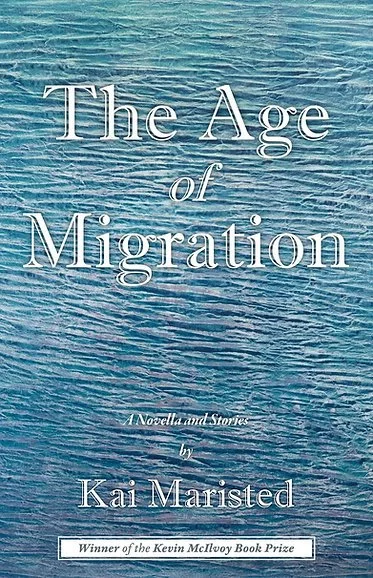
The Age of Migration
Kai Maristed
WTAW Press
242 pages
Few books of short fiction feel as expansive as The Age of Migration. These stories introduce people caught at moments of profound transition—leaving marriages, burying parents, surviving abuse, chasing opportunity, or searching for belonging. Physical migration is only one form of movement here. Every story asks what it means to cross from one version of life into another, and whether arriving somewhere new can ever free us from what came before.
The collection's international settings never feel like postcards. They are fully inhabited places, shaped by culture, history, and everyday life. At the book’s online launch, author Kai Maristed remarked that she prefers writing places she has lived firsthand because “place needs to be experienced to write about with authority.” That commitment is evident throughout.
What unites such varied stories is an extraordinary sense of empathy. The collection introduces readers to immigrants, physicians, missionaries, sex workers, grieving daughters, lonely teenagers, and people whose lives have been shaped by poverty, violence, addiction, or impossible choices. Yet none are reduced to cliches, symbols, or social issues. They remain stubbornly individual, their decisions emerging from recognizable fears and desires rather than narrative convenience.
Asked how she writes characters so different from herself, Maristed explained, “If I can feel my way into the skin of another person, if I take the time to empathize, then I can write about them.” That philosophy quietly underpins the entire collection. Fiction becomes an act of radical imagination, inviting readers to inhabit lives they might otherwise never encounter.
One of the collection’s greatest strengths is its sense of narrative inevitability. Once each story begins moving, its ending feels quietly predetermined—not because the outcomes are predictable, but because every choice grows convincingly from what has come before. Readers may not anticipate exactly where a story is headed, yet when it arrives, the destination feels earned. Interestingly, Maristed noted during the launch that her characters often surprise her as she writes. That paradox—discovery alongside inevitability—gives the stories much of their emotional force.
These stories are all deeply invested in the resilience that persists alongside suffering. The acknowledgements, which read like a story themselves, provide a revealing glimpse into the real-life events that informed this perspective, particularly Maristed’s volunteer work in a rural Haitian hospital. She writes that these experiences taught her “about courage, kindness, and resilience” and concludes simply, “We are all travelers.” That observation feels less like an afterthought than the collection’s guiding principle.
The Age of Migration is a book about crossing borders in every sense. Some crossings are literal, others emotional or spiritual. Some promise freedom while others reveal unexpected costs. The collection insists that identity is never fixed but continually reshaped by the people we meet, the places we live, and the choices we make when the path ahead is uncertain. These stories are compassionate without sentimentality, ambitious without losing sight of individual lives, and beautifully attentive to the fragile moments when one life quietly becomes another.

Allison Renner is the author of Green Light: The Gatsby Cycle and Won’t Be By Your Side. Her fiction has appeared in Ghost Parachute, SoFloPoJo, Gooseberry Pie, Roi Faineant, and others. She can be found at allisonrennerwrites.com.