
“Life Lessons”: Patrick Hueller’s Falling, in Love with Teaching, reviewed by Jenn Hollmeyer
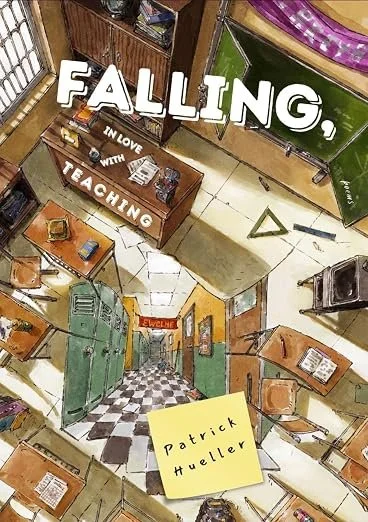
Falling, in Love with Teaching
Patrick Hueller
Poetose (September 2026)
100 pages
Patrick Hueller’s Falling, in Love with Teaching isn’t just about his love of teaching. It’s about falling in love with humanity itself. After all, the veteran teacher writes in “Here’s Your Prompt,” every worthwhile lesson — and every poem in this heartfelt collection — drives at the same question: “In order to endure, must human beings / sacrifice a portion of their humanity?” In a world increasingly dominated by AI and heartless profiteers, this query has never felt more important, and the answer resounds with equal force: “No no no no no no no. / We must restore it.”
Hueller’s poems do this vital restorative work with hope and humor, guiding the reader through his experience as a student, then a student teacher, and finally a teacher. He dips in and out of these points of view the way a reader slips in and out of narratives along a shelf. “Read,” he implores the world’s teenagers after recounting his memory of reading a book at the top of the Sears Tower, “because when you look at your book / you might see humanity simultaneously / up close and also way, way down there.” The collection’s final poem features another childhood memory and perspective shift, in which a fellow student shouts a well-wish to a teacher on the first day of summer vacation after the last day of elementary school. “I see the rest of this scene / from her point of view / or at least vantage point,” Hueller writes, “and I think, no, I say, I speak / for her and for me: You too. / Have a great fucking summer.” This final line encapsulates all the viewpoints and emotions of school as one reads and rereads it with changing inflection and, finally, through a smile.
Hueller primarily writes in first person — about being bullied, proctoring exams, and slipping into the back of a classroom for a professional development lecture — and uses second person to offer pointed advice to students and young teachers alike. His guidance ranges in topic, from how to understand Lord of the Flies to how to teach A Modest Proposal, yet it’s all relevant to every reader of his book because it’s ultimately about how to be a compassionate human being. How do we prevent people from succumbing to base instinct and cruelty? And if some among us do succumb, how can the rest of us just go about our daily lives, pretending it’s acceptable to consume our most vulnerable members of society? Hueller’s poems don’t try to offer answers as much as they point to the importance of asking the questions and listening — always listening — to the responses from young people considering the possibilities for the first time.
Tadeus Charwot’s cover art perfectly captures the shifting perspectives in Hueller’s writing. The illustration shows both a top-down, omniscient view of a classroom and a long view of a school hallway, lockers looming, as a student would see it. Some of the floor tiles have popped out of place, transformed into books. As Hueller describes in his collection’s opening poem, “…books / might not merely be things we hold aloft / but the very ground upon which we walk.”Reading is, indeed, foundational for Hueller, and he aims to make it so for his students, even those who claim college isn’t for them. To these students, he writes “that books [are] not a barricade / but, like you, a battering ram” powerful enough to let light shine through darkness.
Hueller also writes that “… while books aren’t bulletproof, / they’re the closest thing we’ve got.” He offers these words, this shield, in what is perhaps his most poignant poem, “Script for School Shooting Drills.” In this piece he also describes the classic nightmare of falling and jerking awake and realizing “You’re really here, you all are, and you’re really, / truly, blessedly safe.” These words represent a promise, as well as a grave responsibility for the adults who work inside school buildings. We all know what can happen, that the promise of safety sometimes breaks in spite of every best effort.
Public education has seen lots of broken promises, especially over the last eighteen months or so, as the federal administration has reduced spending and diverted funds to private education. While enrollment, test scores, and teacher retention decrease along with budgets, public schools face a difficult road ahead. And yet, by definition, these institutions remain open, free, accessible, and inclusive. And people like Hueller who believe such places are worth supporting continue to show up and pour their energy into their work, into their students, into the future of America.
The final stanza of “Propaganda Unit” might well describe the purpose of education itself:
We must learn to—
or remember to—
or continue to—
let our heart break
when human beings act like human beings
and when they don’t.
Falling, in Love with Teaching serves as a powerful reminder that real wisdom isn’t expressed through rote recitation of dates and facts. It’s expressed through the heart, from person to person, and from poet to reader, in lessons that will last a lifetime.
For more information, please visit Poetose Press.

Jenn Hollmeyer is a writer, a painter, and an instructional assistant for a public school district in the Chicago suburbs. Her poetry chapbook, First Grade, about leaving corporate America to work in an elementary school classroom, is now available from Dancing Girl Press. She won the 2019 Katherine Anne Porter Prize in Short Fiction for her story collection, Orders of Protection (University of North Texas Press). She holds an MFA in writing and literature from the Bennington Writing Seminars. Read more at jennhollmeyer.com.