
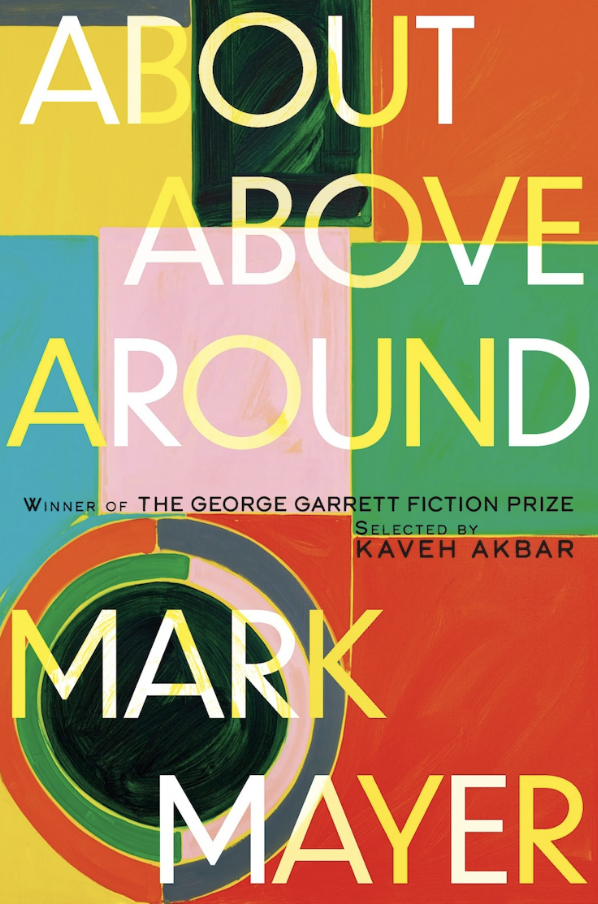
About, Above, Around: 50 Prepositions
Mark Mayer
Texas Review Press
212 pages
What, after all, is a preposition? Mark Mayer, author of About, Above, Around, would tell you they’re “half-invisible words” that, according to the Merriam Webster definition, “show direction, location, or time, or introduce an object.” Prepositions are a part of speech that specify and clarify, orient and portray. What then, do we do with prepositions and what do they do to us? Within that question lies the theme of Mayer’s thought-provoking series of loosely related vignettes, some long, some sort, all loaded with literary magic. Art features in the book, some drawings Gorey-like, while other paintings evoke chalky-like colorful modernism.
That About, Above, Around won the 2024 George Garrett Fiction Prize, judged by by Iranian-American poet and novelist Kaveh Akbar, author of Martyr!, places the collection firmly on the shelf with other books that play with and rise above the commonplace. As Akbar wrote, “About, Above, Around is thrillingly ambitious and deliciously readable, a remarkable vortex of place and mind and spirit illuminating how our lives are shaped, and how we’re held within them.” Mayer’s economic prowess with language illuminates his characters’ lives in distilled, compelling narratives. Consider the shine in this sentence in “Among” about a poet determined to protest a murder, “I suffer and rise among you.” In the end, when the poet is gifted a poem: “It hovered for a second and shattered to the ground.” To the ground we all go…
Words like per, to, than, since, and upon sound oddly sterile, when in fact they lead the way to emotion, a core tenet in Mayer’s work. Many of his stories are in flash form, which leave little space for flair and flourish, or the slow build required in lengthier compositions. Acceleration is key. Mayer’s reliance on prepositions to direct readers, academic as that may sound, makes reading About, Above, Beyond flow with the speed and precision of a driver following Google Map directions through a congested city. In “Through,” a woman contends with grief: “When a soul exits the time layer, it creates a small puncture.” The definition provided in this line—“a small puncture”—is amplified, followed by the prepositional crescendo found here: “All this, tonight, in her car.” In, such a simple word, but the character is in her car, in the puncture, in the grief. Grief’s emotional complexity operates with interiority located in exterior spots. And, as Mayer writes in “Inside,” while “…emotions are the waverings of a confused mind,” they are always situated in time and place.
There’s sweetness in this collection. “By” posits the story of a young girl and her grandfather, who plays with puns. A biplane flies through the sky and the grandfather says, “But darling, it just flew by?” For the rest of the granddaughter’s life, “She cannot recall his gentle ancient smell. Still, almost every plane she hears, and one can almost always hear a plane, she thinks: it just flew by.”
The parsing of duality in a small yet significant personal moment is the entire point of Mayer’s book. Come for the preposition, stay for the sentence. Don’t let this book fly by.

Catherine Parnell is a writer, editor, educator, and the Director of Publicity for Arrowsmith Press. She is co-founder of MicroLit and serves on the board of Wrath-Bearing Tree. Her publications include the memoir The Kingdom of His Will, as well as stories, essays, and reviews and interviews in The Compulsive Reader, Reckon Review, Five on the Fifth, LEON Literary Review, Cutleaf, Funicular, Litro, Heavy Feather Review, Mud Season Review, Emerge, Orca, West Trade Review, Tenderly, Cleaver, Free State Review, The Brooklyn Rail, The Rumpus, The Southampton Review, The Baltimore Review, and other literary magazines.