
“Bella’s Home” by Jacob Strunk
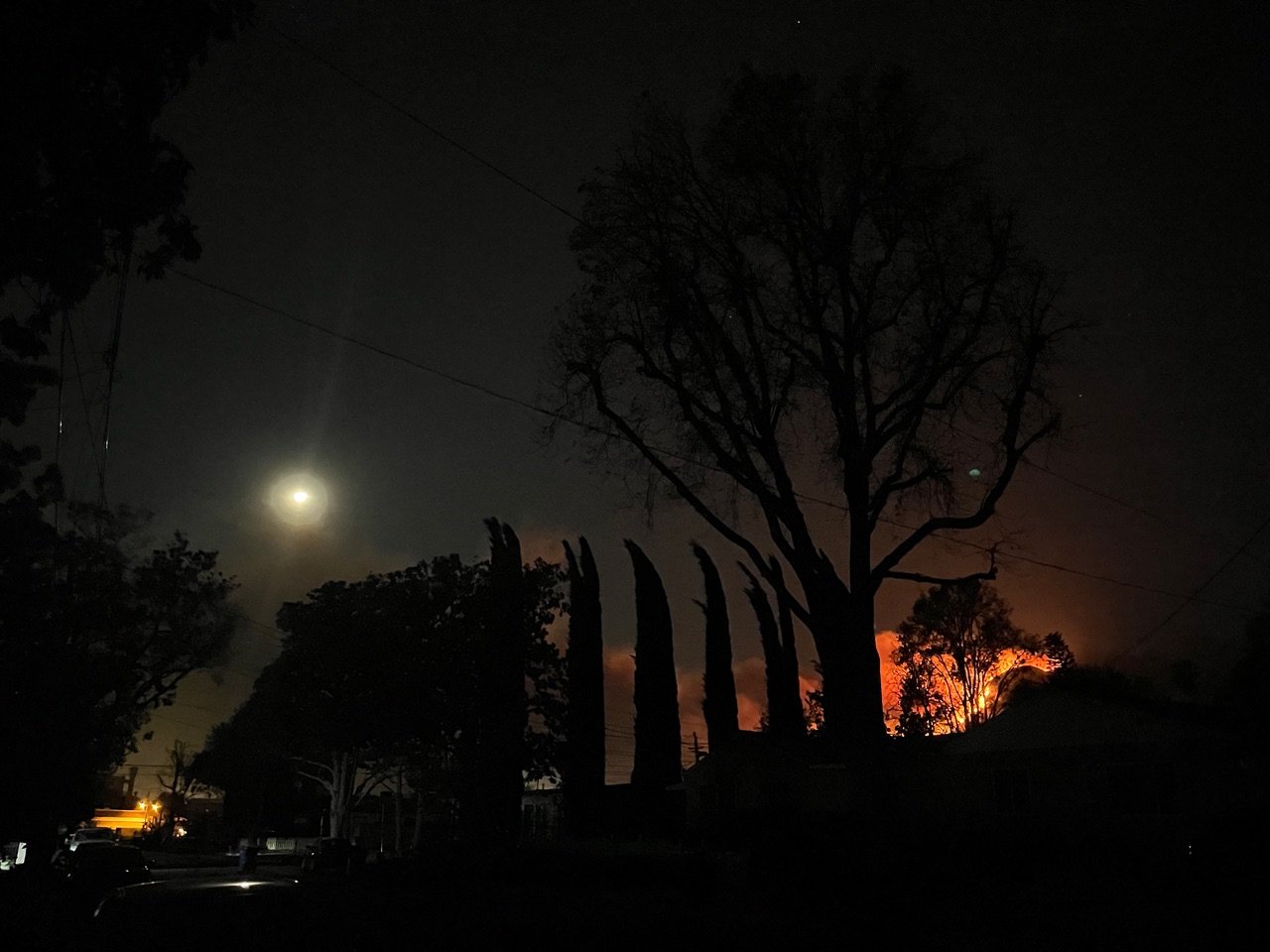
Bella stands in the smoke, scarf wrapped tightly around her nose and mouth, tied in the back. Somewhere in the gloom she hears the whir and whomp of helicopters, the muted shrieks of sirens. The sounds swim around her, like the smoke, nowhere and everywhere. Here in the courtyard, steps from her bungalow, she could be on the moon. The street is gone. So is the parking lot. Both are lost the thick haze, acrid, moving in waves like water.
Last night she saw the glow of the fire to the north, to the east. She heard the cries of her neighbors, their panicked voices, their cars starting and revving; she stayed low, peering out the window as their taillights were swallowed, consumed, and she was left alone. Now, an eerie silence lies over the bungalow court like a blanket, the sirens and whirlybirds and chainsaws far enough to be fantasy – dreams, perhaps. Because surely none of this can be real.
She calls again, her voice trembling as her hands have these past ten years. Lolaaaaa. She’s been calling for what seems like hours, but can’t be. Or can it? Without sun, the smoke swallows time. Without power in the house, Bella is adrift, a castaway. She follows the cracked bricks north toward the gravel lot where she parked her Corolla when she still drove. The empty lot appears suddenly, breaking through the smoke, and Bella calls again.
They knocked last night, of course, and peered through the windows. She hid, crouched behind the bedroom door, peeking out as the young woman from next door called her name, rapped on the windows. Bella, they’d all said, the young woman and later the two black men from the bungalow across from her. Mrs. Warden, we have to evacuate. They tried the doors, shaking the knobs. Still she crouched, even as her knees burned and her hips screamed at her. Bella, please. Eventually they left, and Bella listened to the wind howl in the dark, and she called for Lola, who’d run out the back door, who’d dashed into the night amidst the creaks and groans of the Santa Anas. Lola wasn’t back when the power went out. And she wasn’t back when the sky to the north began to glow, and Bella waited in the dark, watching her neighbors leave, listening to them scramble and shout, their car doors and trunks slamming shut, the wheels of their suitcases purring along the bricks to the parking lot.
Lolaaaaaa!!
Of course Bella wasn’t leaving in the middle of the night, giving herself over to panic. How many times had these winds whipped and howled? She’d lived here all her life, first on Orange Grove as a child, then closer to campus. An apartment downtown with her first husband. A modest but beautiful craftsman in the Highlands with her second. When she retired here, to this bungalow court, she’d sworn this was it. No more moves. No more husbands. She wanted quiet. She wanted to be left alone. She’d been through fires before. How many times? So no, she wasn’t leaving. And certainly not without Lola.
Where the hell is Lola?
She stumbles at the edge of the drive, the little lip where a tree root has muscled its way through the asphalt. How many years has she complained to the owners, warned them they’d have a liability case if someone fell? Now it’s her going to her knees, and it’s her crying out as one of them splits open on the cracked pavement. Through the scarf, her muffled cry dies in the smoke.
A helicopter whirs past above her, a shadow, as she pushes back up to her feet. She feels blood running down her calf and wipes at it absently as she steadies her back against a tree. Where is that goddamn cat? She could have asked one of those nosy neighbors to help her look, but she knew they wouldn’t bother. They’d drag her to their car, force her in, all panicked fear and adrenaline. She’d been through fires, plenty. The fire in 1970 came all the way down to Hastings Ranch, but it’d been stopped. This one would be stopped, too. They all were.
The chop of the helicopter fades, and for a moment, Bella is consumed by a silence so great it’s deafening. She’s never experienced this kind of silence – no children shouting, dogs barking, no car horns blaring or music thumping from the teenage kid who hangs out in the garage across the street – and something like terror wells up in her. She calls for Lola again. And again.
This goddamn cat.
Something cracks, loud and heavy, and Bella recognizes it as a tree falling. She turns and sees the smoke part, sees a figure emerge. Then another. Faceless, formless, another shadow stands at the edge of her vision. She’s walking now, back to the house, she thinks, back to the bungalow she’s called home all these years. But it’s not there. Nor are the trees upon whose branches countless squirrels have perched and chittered at Lola, stoic in the window, her white fur brilliant against the sun. But there is no sun. No squirrels. No cracked brick walkway. Around her, the smoke is a wall, a cocoon, and she realizes the scarf has fallen from her face.
She wipes at her nose and her hand comes away black, and only then does she feel the scraping burn of smoke in her nose, down her throat. She opens her mouth to call out again – for Lola, for anyone – and manages only to cough, to cough until she retches, and then she’s on the ground again, and her chest feels tight, and around her are more figures, and one of them speaks. One of them speaks to her, whispers her name, and she knows its voice well, and far away another helicopter chops the air, and the figures draw closer, begin to resolve, and Bella reaches out her hand.
Artist Statement
Fiction is a lie aspiring to higher truth. I tell stories. I have to.

Jacob Strunk’s genre-bending fiction has appeared recently in Coffin Bell, Marrow Magazine, The Writing Disorder, and his 2023 collection Screaming in Tongues, and has been shortlisted for numerous awards, including a Pushcart, a Glimmer Train short story award, and a New Rivers Press book prize. He makes weird films and television in Los Angeles, where he lives with his partner, their pets, and a few framed movie posters.