
“Keeping House” by Sarah Daley
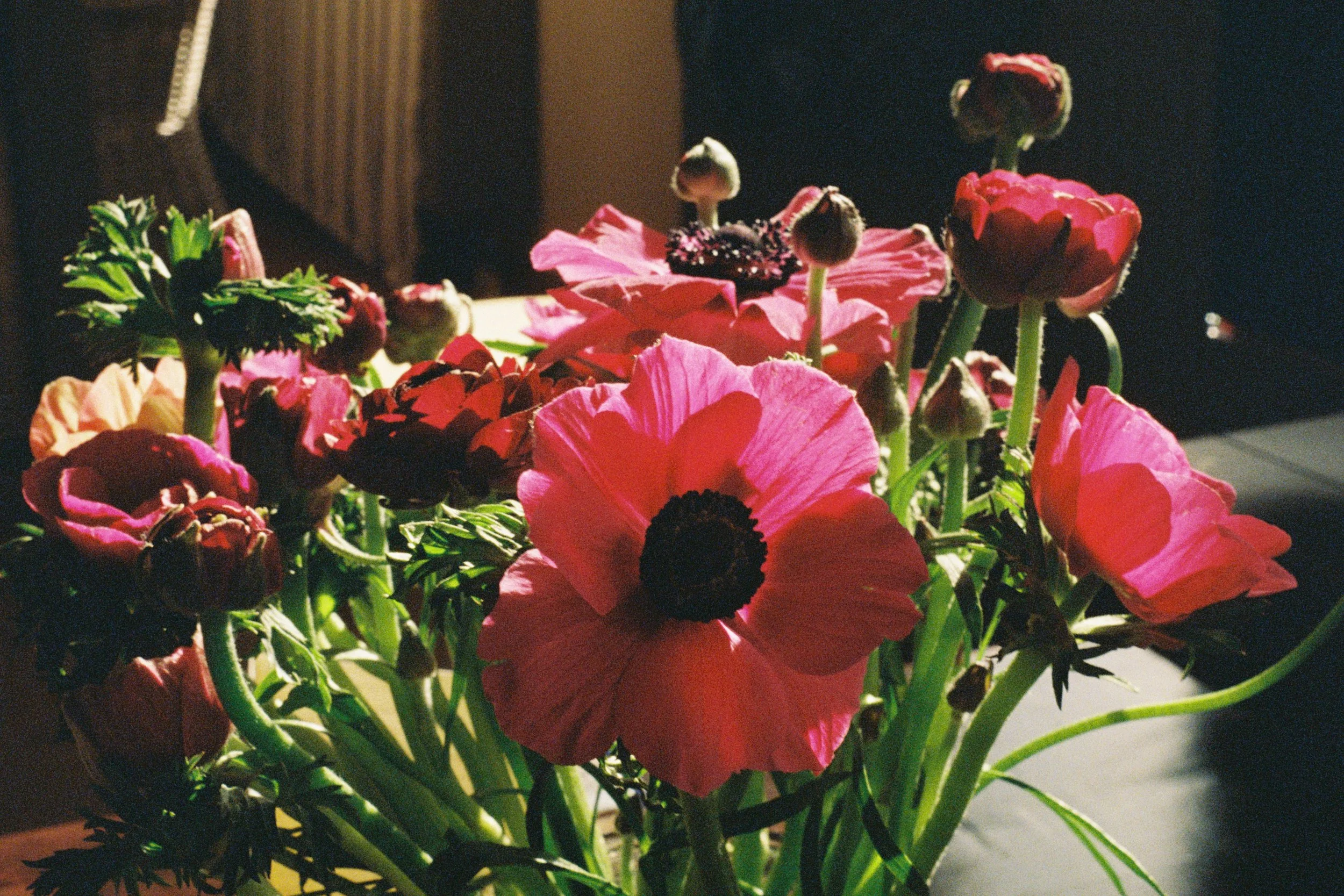
Photo Credit: Ali Elliott
11:51 AM
In ten more minutes, her husband would be home for lunch. She must have it ready. Yet, she had been so busy that morning, taking the children to school, marketing, and ironing. She had wanted to sit down, to read the book that she had started two weeks ago. Or was it three weeks ago? Instead, she turned off the iron and folded up the board, intending to start lunch.
As she crossed the living room, she looked back at the mantle, admiring the roses that she had so artfully arranged in a crystal vase. She had grown the roses in their backyard, tenderly singing to them each night as she served them their supper of fish oil and alfalfa and their apéritifs of distilled water and vinegar. They had begun to sing back to her as their velvet petals opened and their thorns emerged. Their friendly faces followed her every time she mowed the lawn and disinfected the plastic wading pool. Now, they winked at her as she walked to the kitchen. ‘Goodbye,’ she told them.
In the kitchen, she gathered the ingredients for lunch. As she peeled the tomatoes, she thought of the chicken, the lettuce, and the bread that would make this sandwich, one more sandwich in league with the thousands of sandwiches that she had ever made. And with each lunch, the old agonies returned; would her husband enjoy the meal? Would she be able to carry a conversation, full of polite inquiry and tacit concern? Could she maintain her cool demeanor?
Her reverie was interrupted by the coffee cans. ‘Fill us up! Fill us up!’ they called. The coffee cans were telling her how hollow their stomachs were, how tired they were, how they needed their caffeine fix. So, she dragged the burlap sack containing the coffee grounds out from the cabinet and offered them their dark crystals.
She returned to the sandwiches and finished them. She tucked them in under linen napkins embroidered with his and her initials. She scooped them their pillows of cold potato salad and offered them nightcaps of parsley leaves.
Now, lunch was ready, but her husband was late. Unable to stand the suspense, she slipped to the typewriter in the corner, finding solace in the white paper accented by the black ink. The letters were friendly and cheerful as she typed, A quick brown fox jumped over a lazy dog over and over. The keys chirped happily under her touch. She typed everything: letters, recipes, bills, shopping lists. Sometimes she typed just to fill the silence in the room.
Hearing her husband return, she stood up, went to him. Joyfully, she pushed back the shadows and marveled at his wit, his playfulness, his compliments. He reassured her that she was a gem, a wonder. Such a blissful lunch they had, as he regaled her with stories of his work! She longed to drink in every detail of his adventures! For he was a Civil Engineer who filled empty fields with skyscrapers and bridges that he designed. He showed her one of his drawings with its slants and rivets, its panes of glass, its steel beams. She admired the number of rooms, the number of elevators, the number of windows there would be. He kissed her and promised to take her there when it was finished.
Too soon did lunch end. It was less than an hour, and then he had to return to work. When he left, she recalled her days in high school, how sleepy she had been when lunch had ended, and how her eyelids had drooped in American History. The memory was overpowering and seductive. At first slowly, but then with a strong intensity, did the need to lie down and sleep overwhelm her. The edges of the room darkened dreadfully as the sewing machine, television set, and ironing board receded to a white horizon. She saw thick needles on a white plane, their black points growing rounder and rounder until her vision was narrow. She heard the church bells ringing at the ends of a vast desert.
Suddenly, she was at her wedding. She was in the confining dress, surrounded by the overpowering scent of orange blossoms, whose white petals blanketed the aisle. She saw, dimly, the crowds, but could only focus on the bridal bouquet, whose flowers bled on her white gown. The petals were injured and she feared that they would stain the lace. She was surprised to see tears falling onto their leaves, encasing each one as if preserved in glass.
In a moment it was all over; the room came back into sharp focus, and she lay on the couch, breathing, slowly, deeply. She stumbled to the kitchen for an aspirin; yes, an aspirin and some coffee would awaken her. Swallowing them gratefully, she glanced at the friendly hands of the clock. It was 1:32 PM. One and a half hours until the children would be home, begging for sweets and showing off their schoolwork.
She must finish the mending; it had lain, undone, for hours and she must not disappoint her husband. As she grasped the counter, she felt his presence everywhere; in the kitchen, in the study, in the laundry. An overwhelming sense of dread overtook her, threatening to drag her back: she must not disappoint him. She had no excuse when he worked so hard for her and the children.
With immense effort, she submitted herself to the sewing machine, laboriously stitching the rips, the tears, the broken seams. The sewing machine was greedy, its bobbing teeth consuming and puncturing the cloth. It was angry, as she had given it too much, too much to do. It whistled and hissed menacingly, threatening to bite her fingers.
She had worked this hard in the early days of their marriage. She had been young, too young some would say, but she had loved him. She had had to learn how to balance a budget, manage a house, and maintain a façade of cool hospitality. Inwardly, anxiety consumed her; she had known no one in this little town and regarded passing acquaintances as judges rather than confidants. In one of those early years, she had hosted a dinner party for her husband’s colleagues; she had spent hours planning, cleaning, and cooking. In the end, though the china was polished, the meal perfectly timed, and the house sparkling, the conversation had stalled horribly. She had failed to supplement the talk at crucial points; she had blamed herself entirely for the party, which she had regarded as a failure. She had grieved for her errors, convinced that her husband would scold her; but he never did. He had, in fact, praised her lavishly. Rather than comforting her, it fed her cycle of guilt. How long would it be until he noticed her other defects? How long would it be until he scorned her?
This fear haunted her to the point that she wanted to flee; she longed to escape this expectation. Her responsibilities were so crushing that she had once, even begun to make plans; she would travel to Paris or Rome or London. Such fantasies diverted her mind from the weight of reality. She had even gone so far as to liquidate some savings from the bank and obtain a passport. But, in the end, she had lacked the nerve to ever carry out those plans. She loved her family; but such love was poisoned by the agonies of expectation.
It was 2:45 PM when she finished the mending. Half an hour until the children would return. But she must start dinner — her millionth, perfect dinner; she saw the meals stacked row upon row, layer upon layer in her mind’s eye. She never burned anything, never spilled anything, never wasted anything. But how much longer could this continue? How much longer until she made a mistake? She flipped through her cookbook to choose a recipe, but nothing seemed to suit. The cookbook’s photographs mocked her with their technicolor perfection: opaque sauces, whipped potatoes, rare steaks with symmetrical grill lines laid out on spotless china with linen tablecloths. So difficult to achieve, even though she cooked for hours and followed the recipes meticulously.
But the shadows were returning, with a paralyzing intensity, such an intensity that she was suffocating, drowning in a sea of black waves and white skies. She felt so ill that she staggered to the fenced-in backyard, gasping for fresh air. She tumbled onto the lawn. She laid on the grass, breathing slowly, deeply, willing herself to return to reality. She did, but there was a roaring in her ears, a painful tugging which she had never before experienced. It was ten minutes until she could drag herself to a lawn chair. There, she composed herself for the children. When they did return, laughing and chattering, they begged to go to a friend’s house, and she allowed them, immensely relieved to be alone.
Two and a half hours until he returned.
Nearly recovered, she wandered to a clump of lilacs whose beauty and divine smell comforted her. They laughed brightly, merrily. They greeted her and their richness overwhelmed her, and she began to weep; they were such kind friends to her, but she could not set aside her fear of the agonies, the shadows which would eventually claim her. She could not live with her family’s expectations. Her children, her husband, were dear, but she could not return their love without losing the color of life. These tumbling emotions bewildered her; guilt, love, shame claimed her equally, until she realized that she could never escape the shame.
She returned to the house, composed. Quietly, she fried the steaks and boiled the green beans for dinner. She whipped a meringue and paired it with a lemon pie. She then laid the linen cloth on the table and lit the silver candles, which she only did on special occasions. When the food was finished, she arranged it on her silver platters, which had been wedding gifts. She set each place with their best china and glassware. When she had finished, she stepped back to admire her masterpiece of domestic perfection.
And then, she left.
Artist Statement
I wrote the first draft of this story in 2011 and set it aside for nearly a decade before returning to it during the early days of COVID. Spending so much time indoors, immersed in the domestic realm gave me a renewed awareness of the artistry in these everyday practices. The colors, textures, and sounds of the domestic world linger in my subconscious. Indeed, I often dream of past homes I lived in; there is something that just gets under one's skin about a domestic space one has created. Cooking and sewing, in particular, are activities I enjoy; they require skill, patience, and creativity. During the isolation of COVID, I developed a new appreciation for the almost magical aspects of domestic activities, and how they influence interior life. So I chose to revise my story and add a touch of magical realism.
Yet the main message of this story from my first draft remains: what happens when the demands of daily domestic labor (cooking, cleaning, sewing) become obligatory rather than chosen? How can the magic of these practices be diminished, and how does the emotional labor inherent in them complicate or even taint the artistic aspect? My story explores this tension between enchantment and obligation, seeking to illuminate the hidden artistry and labor of domestic life, themes particularly relevant now with so many conversations centering on women's emotional labor.

Sarah Daly is an American writer whose fiction, poetry, and drama have appeared in fifty-five literary journals including New Feathers, Moss Puppy Magazine, Shot Glass Journal, and The Avalon Literary Review, and Autumn Sky Daily. She is inspired by the intersections of gender, culture, and technology in our world.