
“The Hunger of Becoming”: Carol Parris Krauss’ review of HUNGER by Danielle Jones
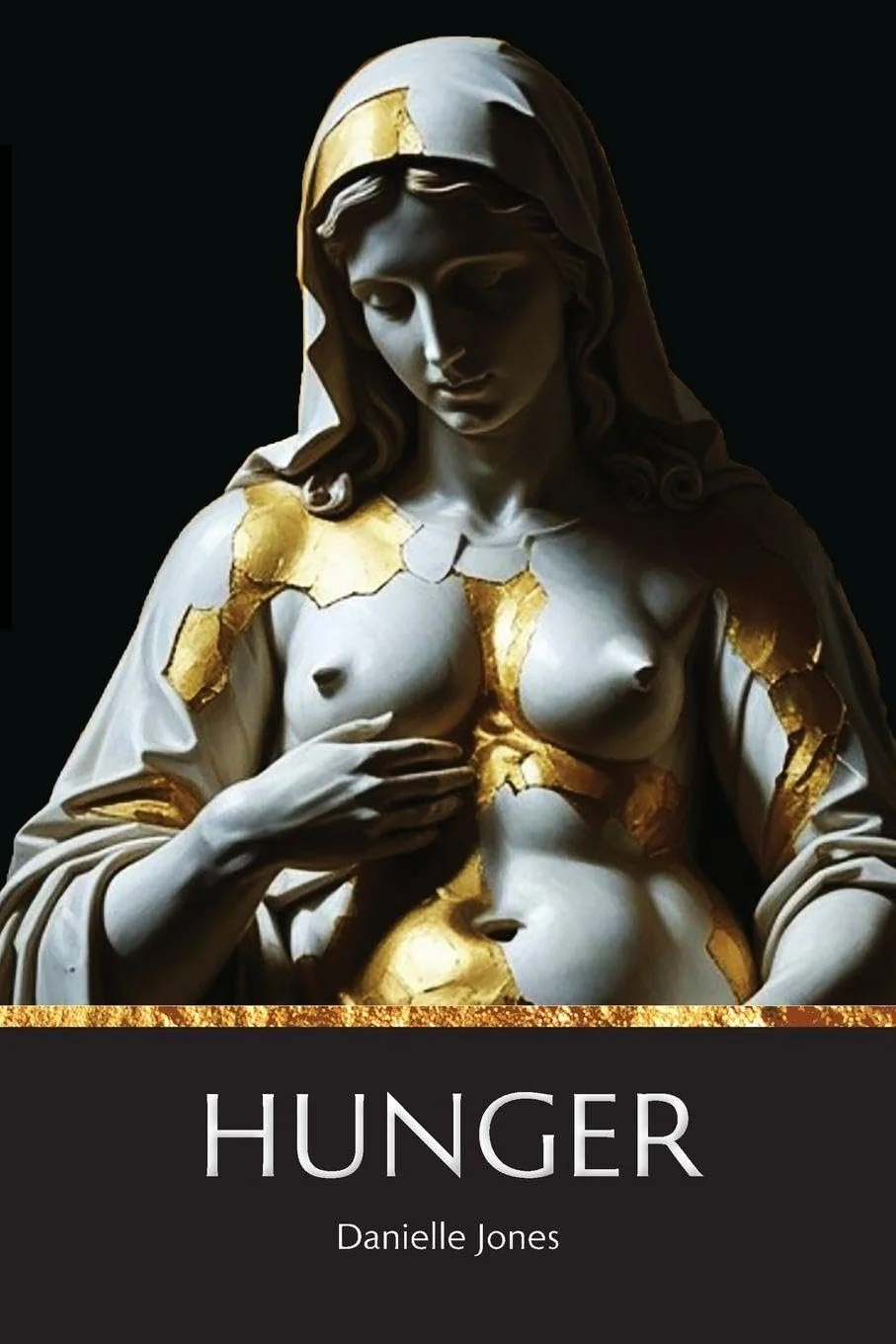
Hunger
Danielle Jones
Bordighera Press
Nov. 4, 2025
128 Pages
In the poetry collection Hunger by Danielle Jones, the poet takes the reader on a journey through trauma, survival of trauma, everyday motions and moments, and navigation of various generations to the ultimate destination of becoming, which she admits can be a moving target. Jones’ debut book, published by Bordighera Press, is divided into three sections. Section I focuses on origin and material hunger, and Section II includes poems on migration, inheritance, and domestic abuse. The last section, III, explores delving into the future, revision, and becoming. All sections stress using your hunger. Jones, a poet and educator, teaches writing at the University of New Hampshire and has gathered such accolades as a St. Botolph’s Club Emerging Artist Award, a Mass Cultural Council Artist Fellowship, and a Brother Thomas Foundation Fellowship. She was the recipient of a Rona Jaffe Writer’s Award.
Section I begins with the visually impactful “Variants of a Roman Landscape.” The reader, through the rich language, watches a young boy frolic “from stone to-stone” and glimpse “At a street cafe, a/man with whiskers/shadowing his face/sips his first beer of the/ evening.” This idyllic stroll is followed by the intriguing “The Spy,” where the narrator sneaks up steps on bare feet to watch her brother dance, and then leans in to kiss his partner. Jones promises to “keep this kiss/for myself.” The ease with which Jones to visually pauses, recaptures, and relays these moments enables the reader to become a part of the scenarios. Section I can also be more brutal than serene. In “Osvaldo Runs Away to Join the Foreign Legion,” the reader is given a snapshot of the brutality dispensed to the Italian Underground by Hitler. In the next-to-last stanza, we find Osvaldo’s body naked with a bullet hole in his head and a “Depressed skull.” Those around him “hoping/they wouldn’t be/one of the ones/rounded up/and slaughtered. The hunger for survival.”
Section II first takes the reader from Italy to halfway across the world to the South of the United States. The second missive, “Portrait of a Woman in Kitchen,” makes use of olfactory and auditory imagery. The reader can smell the “pork in the pan, bread baking.” Jones paints snapshots of the magically routine motions and makes the reader feel as if they were in the corner listening to the “espresso hissing.” Jones moves effortlessly across time, continents, and emotions to make each penned poem accessible to the reader.
The third section entreats the reader to look to the future. To take the past, the traumas, the serene, and the quaint on your journey to becoming. And Jones implores the reader to use their hunger as they move through this process. “Saving Myself” is the last poem of her collection. She leaves the reader with this sage advice, "I'd sing, a silent film star/strangling/even try/ to save you. I was glad to leave.” To become myself.

Carol Parris Krauss is honored to have published poetry in Louisiana Lit, ൪uartet, the Arkansas Review, Salvation South, Eclectica, One Art, Story South, The South Carolina Review, and the Mid/South Sonnet Anthology, among others. Fernwood Press published her full-length book (Mountain.Memory.Marsh.) in November of 2025. Carol was born in S.C., to mystical mountain people, raised in NC, and attended Clemson University. She currently lives in Virginia with her St. Bernard, Martha June.